01 / THE SEQUEL TESTTHE SOPHOMORE ALBUM THAT COULD NOT AFFORD TO BE ORDINARY
By August 2005, Kanye West had already accomplished the unlikely part. The College Dropout made a successful producer into a solo rap star and challenged the idea of what a commercial hip-hop centerpiece had to sound or look like. It brought the soul samples, the school metaphors, the self-conscious humor, the family stories and the spiritual doubt together in one audacious debut. The album had sales, hits, Grammys and enough cultural resonance to ensure that the second record would be treated as an event. But success creates its own trap. An artist can repeat what worked and be accused of standing still, or chase change and risk losing the audience that believed in the first vision.
That is what makes Late Registration so important to our 4DK history of the era. Kanye did not record The College Dropout Part Two. He took the foundation—the pitched-up soul language, the ordinary-man perspective, the willingness to speak about religion and class—and gave it a larger architecture. He wanted a record that could sound intimate in headphones and immense coming through speakers. The difference between an interesting young artist and a long-term creative force is often whether he can make the second statement feel necessary. Kanye cleared that bar with room to spare.
The numbers put the pressure in perspective. The College Dropout opened with roughly 441,000 US copies. Late Registration, released August 30, 2005, debuted at No. 1 with roughly 860,000—nearly twice its predecessor. A big opening is not the same as a great album. We can all name blockbusters that stopped mattering once the promotion ended. But on this record, the sales reflected something deeper: the audience from the debut had stayed, and a wider audience had come to see what he would do next. His second Grammy for Best Rap Album followed in 2006, along with an Album of the Year nomination. The awards are part of the historical record; the music is what keeps the argument alive.
And we have to remember the moment. 2005 belonged to multiple competing visions of rap stardom. 50 Cent’s The Massacre was a massive commercial force. Jeezy’s Thug Motivation 101 was reshaping trap’s mainstream vocabulary. Common released Be, with Kanye crucial to its sound. The Game’s The Documentary was a West Coast event. Wayne was moving toward Tha Carter II at the end of the year, before the mixtape run that would transform his reputation. Kanye was not operating in an empty field. His achievement was forcing another kind of album—funny, political, vulnerable, luxurious, orchestral and still unmistakably rap—to stand at the center of that conversation.
02 / THE SOUNDSOUL SAMPLES WITH A BIGGER SKY OVER THEM
The most obvious creative shift was the collaboration with Jon Brion, whose background in richly arranged film music helped Kanye think beyond the standard loop. Listen to the strings swelling, the horns answering the vocals, the keyboard colors and the little changes that make each song feel like it has a second or third room behind the main beat. What we hear is not Kanye abandoning hip-hop production for an orchestra. It is an attempt to treat sampling, drums and live instrumentation as parts of the same language. The record is polished, but rarely sterile. Its most lavish moments still move with swing.
That distinction is critical because the industry loved reducing Kanye to the chipmunk-soul formula. The debut already showed much more range than that stereotype allowed, and Late Registration makes the reduction impossible. “Heard ’Em Say” finds power in restraint. “We Major” builds a world around horns and layered voices. “Roses” makes warmth and anxiety coexist. “Addiction” is subdued and slippery. “Crack Music” sounds like a protest rising out of the drums. “Gone” develops across its verses until the closing performance feels like a different scene from the opening.
The production team was bigger than the familiar Kanye–Brion headline. Just Blaze produced “Touch the Sky,” and Warryn Campbell, Devo Springsteen and others helped shape different parts of the album. That matters to our analysis: the sound is not the product of one man secretly playing every instrument. Kanye’s strength was in direction as much as beat-making—knowing who could help realize a vision, letting other voices matter, and still making a collection of different collaborators sound like one album. It was a major development in what a mainstream rap producer-artist could demand from the recording process.
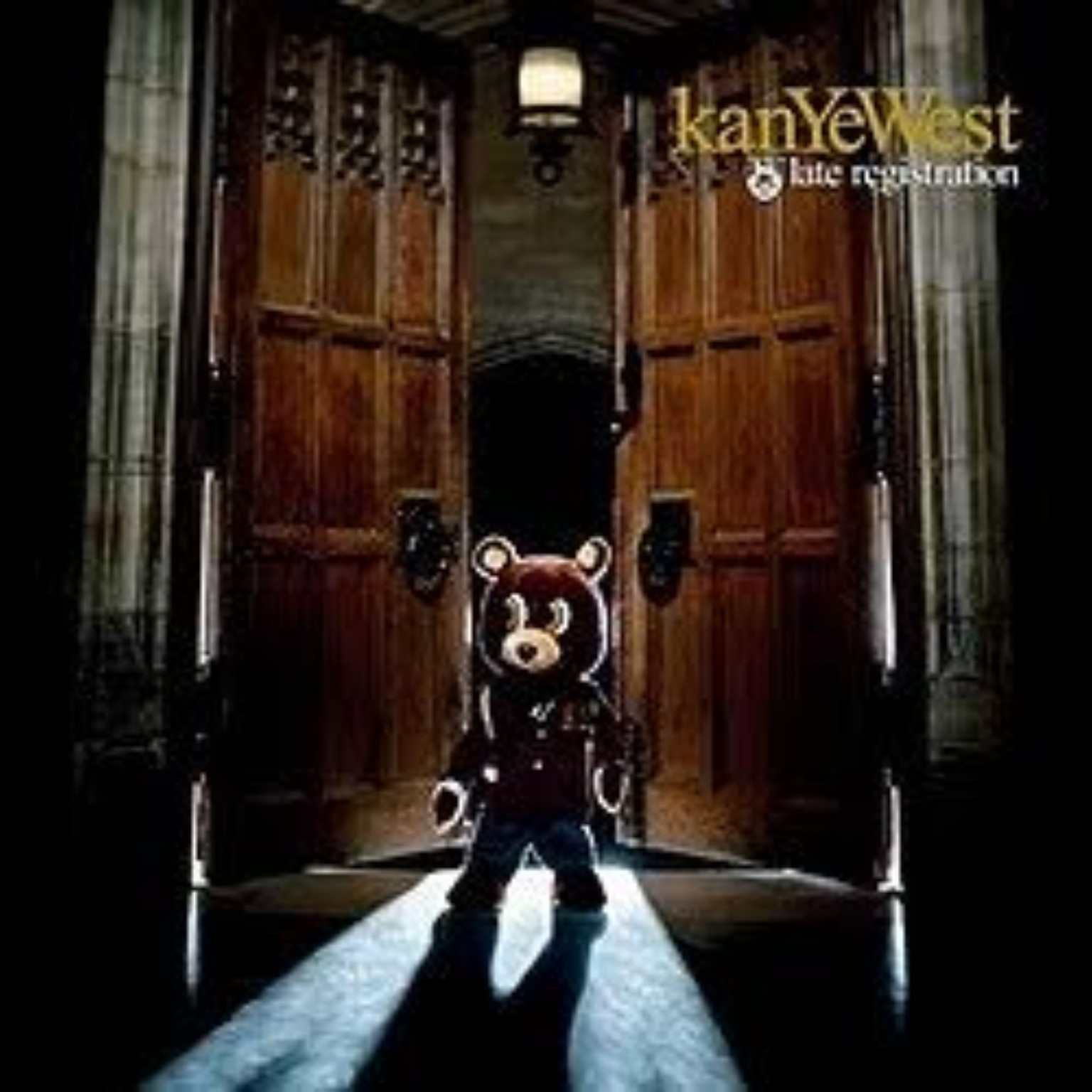
The original cover tells the same story. The Dropout Bear stands between large wooden doors in an imposing school building. The figure that felt like an outsider on the first album now walks into a much grander institution, but the bear is still small compared with the architecture. There is victory here, yet there is also uncertainty. Kanye has gained access to the building; he has not stopped questioning who makes the rules. That is the album in one image.
03 / THE WRITINGBIGGER AMBITION, MORE CONTRADICTIONS, MORE HUMANITY
The version of Kanye we meet here can be hilarious, self-absorbed, politically provocative, tender and insecure within the same stretch of music. That is why reducing the early albums to production classics misses too much. On “Roses,” a family’s experience with health care cuts through the fame. On “Hey Mama,” the celebrity posture disappears entirely. On “Crack Music,” Kanye connects the story of Black popular music to systems of power and profit. Those observations are not all complete policy arguments, and his comparisons do not always resolve neatly. That is the nature of a songwriter making records in real time rather than writing a textbook.
At the other extreme, “Gold Digger” is brilliantly engineered popular music built around cutting, sometimes uncomfortable caricature. “Diamonds from Sierra Leone” celebrates personal victories; the remix asks the artist to examine what luxury may be hiding. The contradiction is not a flaw we need to erase to call the album a classic. It is the tension that makes it worth discussing. Kanye wants the chain, the recognition and the enormous stage. He also wants to ask how wealth is created and who suffers while stars celebrate it. That uneasy balance is one of the defining voices of mid-2000s rap.
We also hear a rapper becoming more comfortable beside the elite. He can hold court with Nas on “We Major,” take part in a massive Roc-A-Fella moment alongside Jay-Z on the “Diamonds” remix, and let Cam’ron and Consequence deliver strong verses on “Gone” without disappearing. Sometimes he wins with technical detail; sometimes he wins with a performance only he could give. The evolution from producer who happened to rap to fully formed star is the heart of this issue.
04 / 2005 IN REAL TIMEWHAT DID THIS ALBUM MEAN NEXT TO THE ERA’S ELITE?
To appreciate where Late Registration put Kanye, we have to place it next to the giants rather than pretending there was only one throne. Jay-Z had already established a remarkable run and announced a retirement from solo albums with The Black Album in 2003; in 2005 his legend was a measure every ambitious rapper could hear. Nas remained a lyricist’s lyricist. Eminem had set an extraordinary commercial and lyrical standard. 50 Cent was still an event-level mainstream force. In the South, T.I., Jeezy and Lil Wayne were writing different blueprints for the next era of influence.
Kanye did not simply outrap every one of those artists on Late Registration, and saying so would flatten what made them individually great. His breakthrough was changing the terms of the argument. He could compete in first-week sales, dominate radio, bring thoughtful album material into the mainstream and arrange songs as if he were scoring a film. The question was no longer whether the Roc-A-Fella producer deserved a microphone. It was whether anyone else was making a rap album with this particular combination of range, cohesion and scale.
The collaborations themselves underscored his position. “We Major” features Nas, while the “Diamonds” remix features Jay-Z—two towering figures whose rivalry had defined a major part of the preceding era. “Touch the Sky” introduced Lupe Fiasco to a much wider audience. Paul Wall and GLC brought distinct regional personalities to “Drive Slow.” Common’s brief solo showcase on “My Way Home” placed the album in conversation with socially conscious Chicago soul rap. The Game, Brandy, Jamie Foxx and Adam Levine further stretched its reach. This was not a random celebrity roll call; at its best, it was a statement that Kanye could bring multiple musical worlds into the same room.
By the end of 2005, the case for Kanye as one of hip-hop’s defining creative figures was no longer built on the promise of one dazzling debut. He had repeated, expanded and complicated the achievement. The records that followed would push in other directions, but Late Registration is where the argument shifted from arrival to staying power.
05 / THE MIDWEST DEBATEWHY 4DK PUT IT ABOVE THE MARSHALL MATHERS LP
Our ranking is on record: Late Registration sits at No. 1 on 4DK’s all-time Midwest hip-hop albums list. Eminem’s The Marshall Mathers LP is No. 2, Common’s Like Water for Chocolate No. 3 and The College Dropout No. 4. That was not a casual choice or a dismissal of Detroit. We explicitly recognized Eminem’s lyrical advantage and how powerful his defining classic remains. But when we judged the complete musical experience—production, sequencing, themes, performances, atmosphere and long-term replay—we gave Kanye the narrow edge.
That is the distinction we want readers to understand. An album ranking is not a straight list of the best technical rappers, and it is not a sales chart with adjectives added afterward. We can admire Eminem’s command of language, intensity and historic cultural reach while finding more colors inside Kanye’s 2005 record. Late Registration can make room for “Roses,” “We Major,” “Drive Slow,” “Hey Mama,” “Gone” and “Crack Music” without losing its identity. Its weakest passages are mostly brief connective skits rather than a collapse of the musical vision.
If someone chooses The Marshall Mathers LP because the raw lyrical impact and social shock outweigh the arrangements here, that argument deserves to be heard. Our verdict is that Late Registration achieves more kinds of excellence inside one album. This is one of the rare ranking debates where the final order could change for somebody who emphasizes a different part of the craft. Our specific 4DK standard puts the music first without treating the writing as optional.
06 / THE LEGACYTHE RECORD THAT GAVE KANYE PERMISSION TO KEEP EXPANDING
The long-term impact goes beyond whether a younger producer directly copied a horn line or an arrangement. Late Registration helped normalize the idea that commercial rap could be elaborately orchestrated without sacrificing drums, hooks or the artist’s own slang. It showed that talking about family illness, education, class or religion was not incompatible with a massive radio single. It reminded major labels that a rap album could support sharply different emotional registers—and that those differences could be the selling point rather than a problem to hide.
The influence is not exclusive. Other artists had used live players, lush instrumentation, soul samples and serious themes before Kanye, and hip-hop’s musical range has always been broader than a single superstar. What this album did was concentrate those tools into a blockbuster in the center of the genre’s commercial life. That visibility matters. For a generation of producers and writers, it strengthened the case that ambition in arrangement could be rewarded rather than treated as excess.
The album also shaped how we interpret the next chapter of Kanye’s catalog. Graduation chased a more stadium-sized sound; 808s & Heartbreak later made vulnerability and melody central to an even stranger shift. Those albums are not simply copies of Late Registration. The connection is that this sophomore record proved Kanye was willing to rebuild the frame around himself whenever he thought the music demanded it. The first album opened the door. The second showed he was willing to redesign the room.
And a word about legacy in 2026: Kanye’s later public conduct and controversies have complicated how audiences engage with his music. We do not need to erase that context, nor pretend the 2005 record’s craft disappears because its creator’s story continued. Our role in the Album Files is to study what the album did, what it sounded like, what it meant in its time and which parts still hold up under serious listening. On those terms, Late Registration remains an essential rap classic.