The NBA version of Allen Iverson became so famous that the college version can get reduced to a sentence: Georgetown, two years, No. 1 pick. That skips the part that matters. Georgetown was where the raw speed, fearlessness, defense, style and defiance started becoming the complete basketball identity the league would meet in 1996.

00. THE SECOND CHANCE CAME BEFORE THE BASKETBALL.
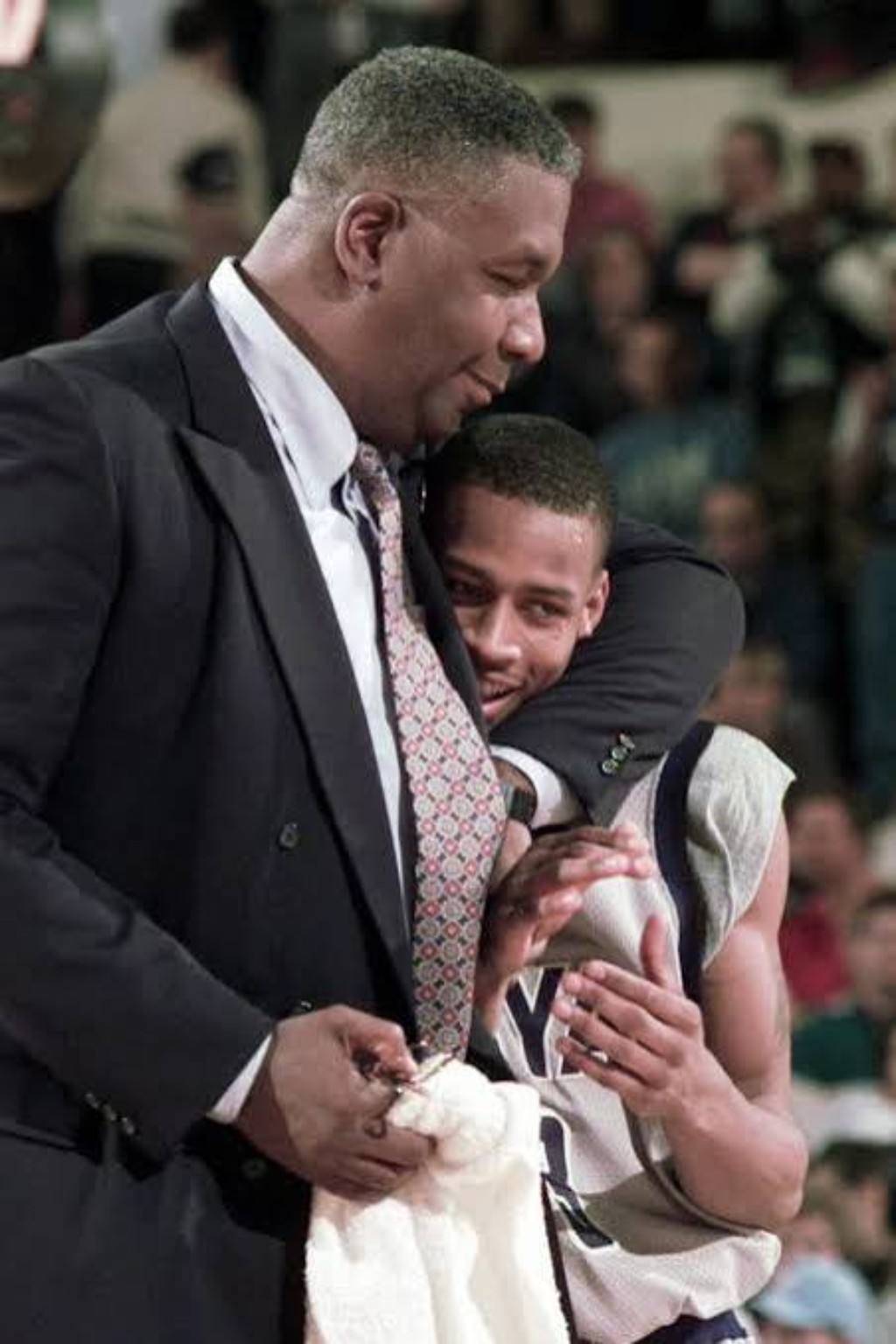
Iverson arrived at Georgetown with more hanging over him than basketball expectations. His final high-school years had been disrupted by the Hampton bowling-alley case, incarceration and an uncertain academic path. His mother, Ann Iverson, sought out John Thompson while her son was still incarcerated. Thompson eventually offered the opportunity — but not without demanding commitment, discipline and forward movement.
That part of the story matters because Thompson was never simply the coach who handed Iverson a basketball. For Iverson, he became a coach, authority figure and protector. Georgetown gave him structure at a time when the rest of the country was already forming opinions about who he was.
The relationship lasted beyond college. When Iverson announced he was leaving early for the NBA in 1996, he made clear that Georgetown had prepared him for life beyond basketball and that Thompson would still be the first person he called when problems came.
01. THERE WAS NO FRESHMAN WARM-UP PERIOD.
Iverson averaged 20.4 points, 4.5 assists and 3.0 steals as a freshman. He won Big East Rookie of the Year and, at roughly six feet tall, was already good enough defensively to win the conference's Defensive Player of the Year award.
That combination is the first thing that gets lost when the Georgetown years are remembered only as the setup to the NBA. The scoring was real immediately, but so was the pressure he put on ballhandlers. He wasn't waiting for the game to come to him. He was speeding the entire floor up.
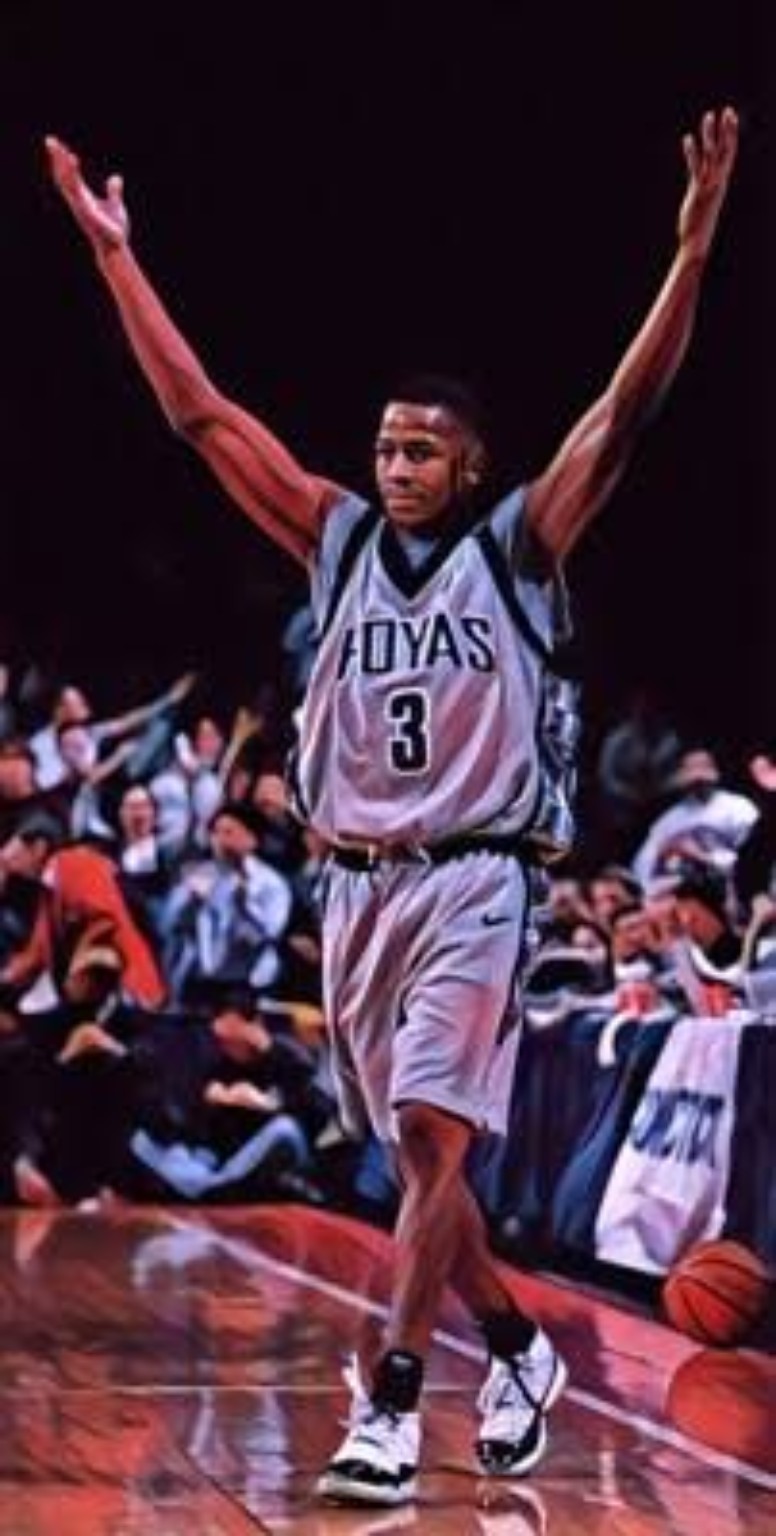
Georgetown went 21–10 and reached the Sweet 16. Against North Carolina in the regional semifinal, Iverson scored 24 points and grabbed eight rebounds. He was already carrying himself like somebody who expected to belong on the biggest stage.
02. THE ATHLETICISM GETS FORGOTTEN.
The crossover and the scoring eventually became the most replayed pieces of the Iverson package. Georgetown Iverson reminds you how much pure athletic violence was underneath all of it.
He was dumb quick. Explosive at six feet. He could catch lobs, rise in traffic, chase plays from behind and attack bigger bodies without acting like he understood he was supposed to be smaller. The Marcus Camby matchup made the contrast obvious: one of the country's best shot blockers at 6-foot-11 on one side, and Iverson repeatedly trying to turn the paint into his space anyway.
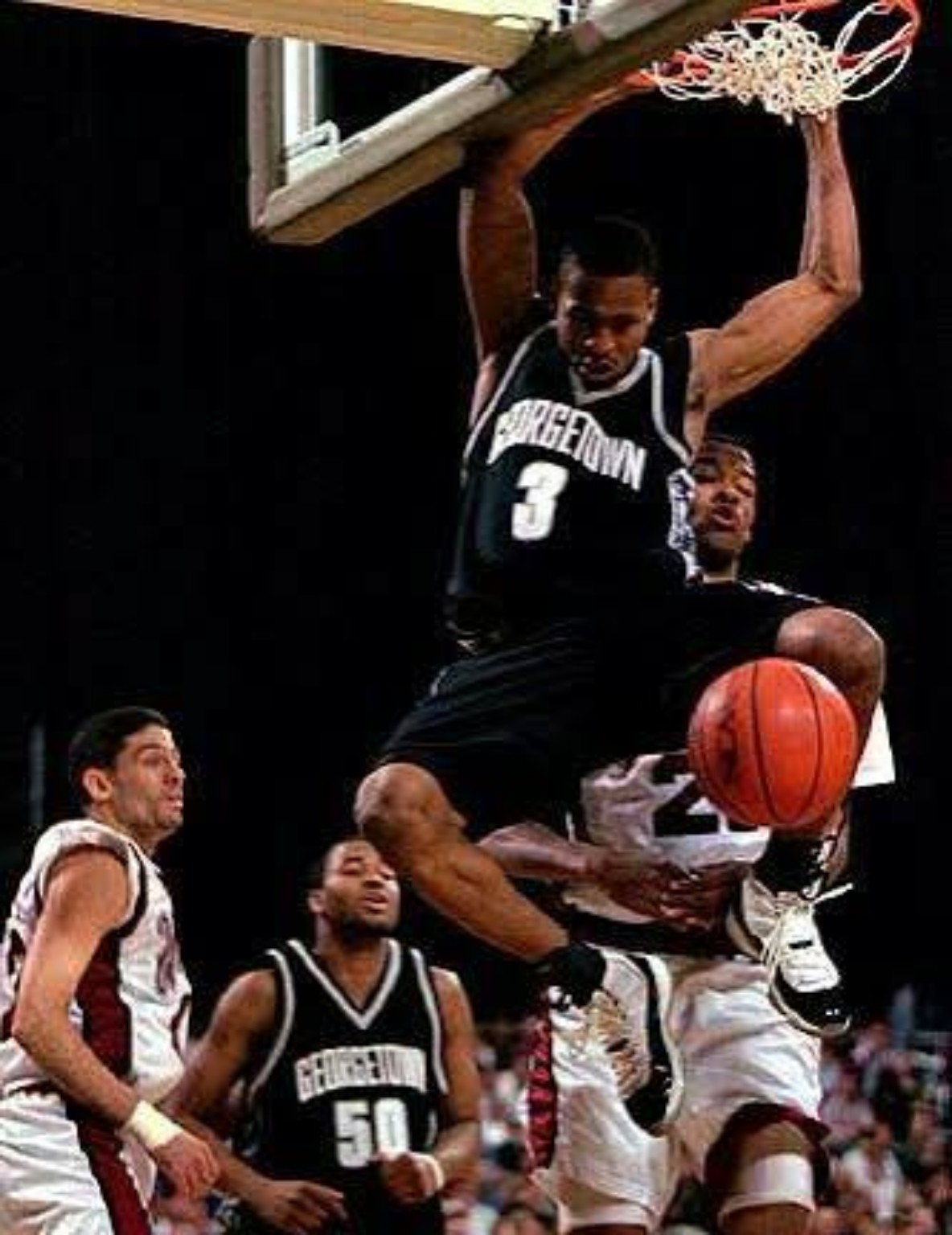
That is a big part of why the defensive awards make sense. His defense wasn't about standing in the perfect textbook stance for 40 minutes. It was speed, anticipation, hands, recovery and chaos. He could turn one bad pass into an instant layup before the other team understood the possession was over.
03. RAY ALLEN KNEW WHAT THE BIG EAST HAD ON ITS HANDS.
The 1995–96 Big East had Iverson at Georgetown, Ray Allen at Connecticut, Kerry Kittles at Villanova and John Wallace at Syracuse. Iverson and Allen were not waiting for the NBA to become part of the same era — they were already meeting on one of college basketball's hardest stages.
Iverson averaged 25.0 points as a sophomore. Allen averaged 23.4 for UConn. Georgetown beat Connecticut 77–65 late in the regular season, then UConn answered with a 75–74 win in the Big East championship game.
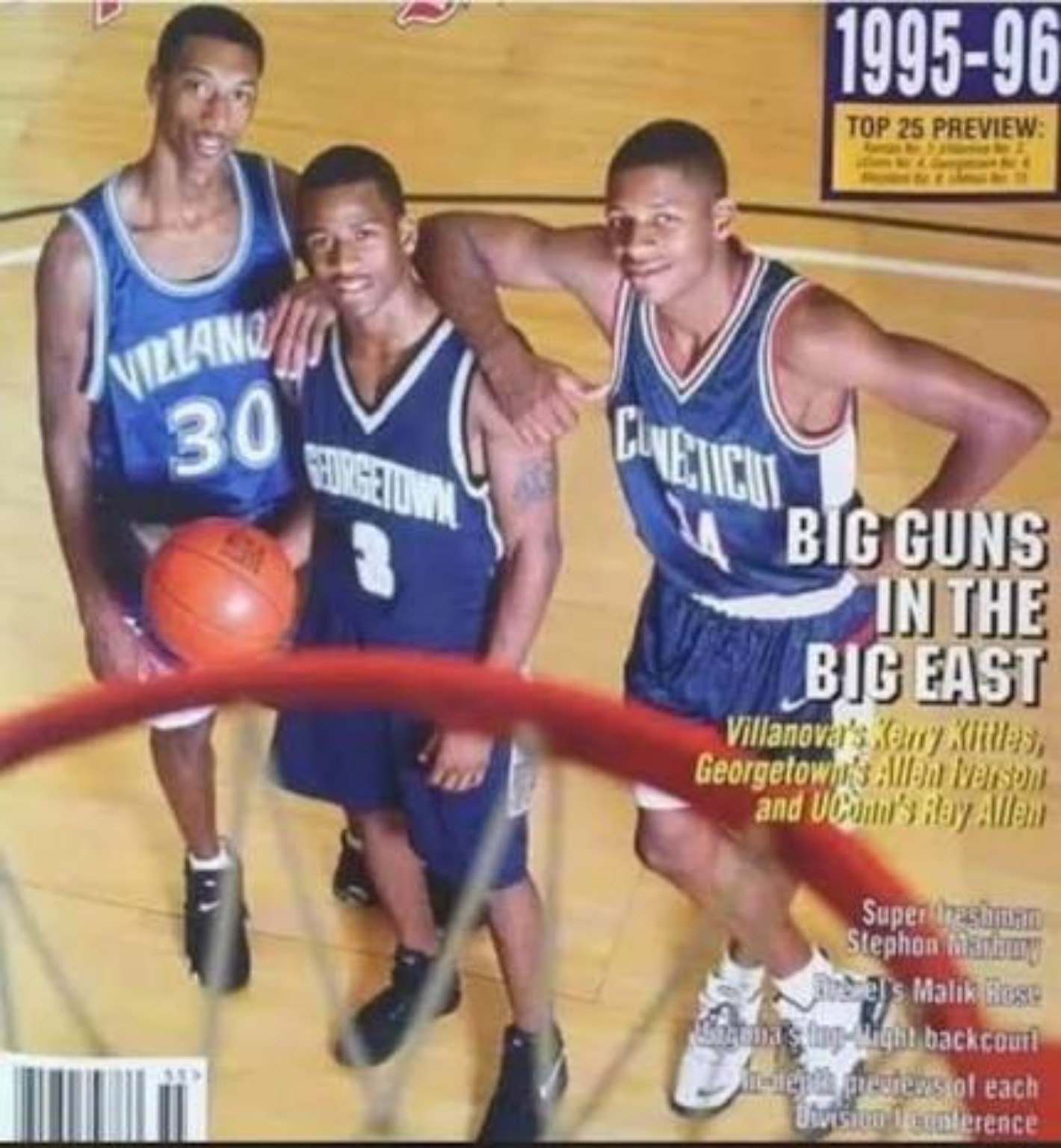
Those games are part of the origin story because they show Iverson against peers who were going to matter at the next level. This wasn't a star collecting numbers in a vacuum. It was a loaded conference, and the future No. 1 pick was right in the middle of it.
04. THE STYLE WAS THERE BEFORE THE BRAIDS.
College Iverson didn't look like the final NBA version yet. No signature braids. No arm sleeve. No Question sneakers. But the presence was already there.
The short fade, the Jordans, the way he moved, the way he celebrated and the way he played bigger than his frame — the style wasn't something Reebok invented later. The NBA version amplified it. Georgetown already had the first draft.
05. THE SOPHOMORE LEAP MADE THE NBA DECISION EASY TO UNDERSTAND.
As a sophomore, Iverson jumped to 25.0 points, 4.7 assists and 3.4 steals while shooting 48 percent from the field. He repeated as Big East Defensive Player of the Year and became a consensus first-team All-American.
The team jumped with him. Georgetown finished 29–8, ended the season ranked fourth in the AP poll and reached the Elite Eight. Victor Page gave the backcourt another scorer, Othella Harrington and Jerome Williams brought size and toughness, and the Hoyas looked like a team with enough talent to make a real March run.
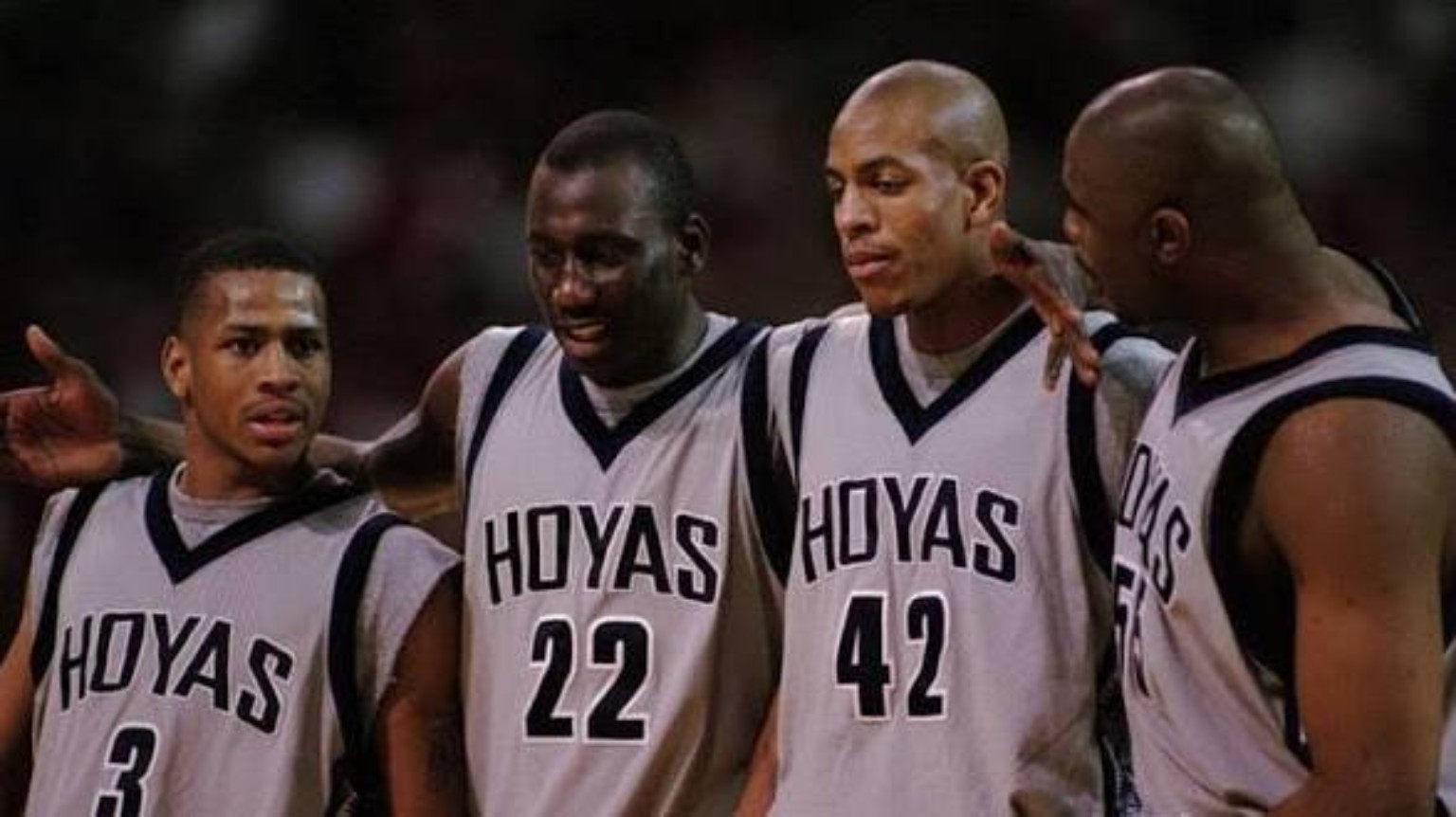
UMass ended it, 86–62, one game short of the Final Four. Marcus Camby had 22. Iverson scored 23 but shot 6-for-21. It was a hard ending, but it did not change what the two-year body of work had established.
06. BY DRAFT NIGHT, THE QUESTION WASN'T WHETHER HE BELONGED.
The 1996 class was ridiculous: Iverson, Marcus Camby, Shareef Abdur-Rahim, Stephon Marbury, Ray Allen, Antoine Walker, Kobe Bryant, Steve Nash, Jermaine O'Neal and more.
Iverson still went first.
That matters when remembering the doubts attached to him at the time. He was small for an NBA superstar. His life before Georgetown had been scrutinized nationally. He had only played two college seasons. None of that stopped Philadelphia from making him the No. 1 overall pick.
07. 4DK VERDICT: THIS IS WHERE THE ORIGIN STORY HAS TO START.
If The Answer Files begins with the NBA, it starts too late.
The Georgetown years explain the version of Iverson Philadelphia drafted: the speed, the toughness, the defensive instincts, the willingness to carry offense, the refusal to be intimidated by size, the comfort in high-pressure games and the bond with a coach who could challenge him without trying to erase him.
John Thompson gave him an opportunity when his path had narrowed. Iverson turned that opportunity into 1,539 points in 67 games, two Defensive Player of the Year awards, two NCAA tournament runs and the top spot in one of the deepest drafts ever.
GEORGETOWN KNEW THE PERSON.
The next file opens the full 4DK thesis: why Iverson wasn't just part of the culture — he became one of its defining basketball figures.
CONTINUE TO FILE 001 →College production, awards and team records checked against Sports-Reference; 1994–96 Georgetown/John Thompson historical context checked against contemporary Washington Post reporting.