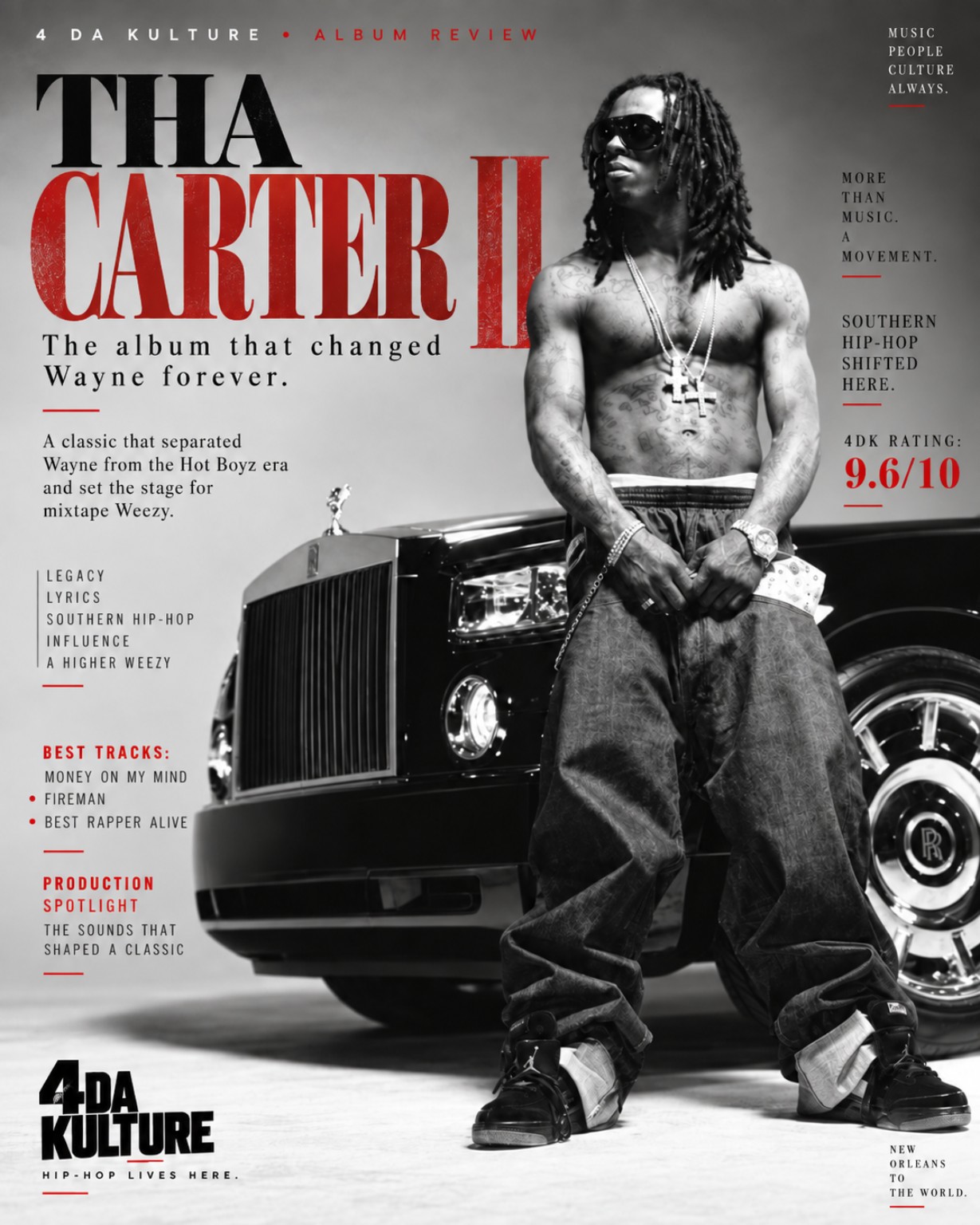
Tha Carter II feels like the exact moment Wayne stepped into a different phase of his career. Wayne had already started showing where his pen was headed on Tha Carter in 2004. “Go DJ,” “Bring It Back,” “I Miss My Dawgs” — that first Carter was where the bars started becoming a bigger part of the conversation.
But Tha Carter still sounded like Cash Money. Tha Carter II sounded like Wayne.
THE BREAK FROM THE OLD CASH MONEY SOUND.
This was Wayne’s first Carter album without Mannie Fresh driving the sound, and that separation was necessary. At some point, Wayne had to grow out of the old formula. The crazy part is the replacement plan wasn’t built around one superstar producer. Different producers came in, gave Wayne different pockets, and that nigga adapted to all of it.
The beats didn’t overpower him. They gave his bars somewhere to live.
That is why “Money on My Mind” hits so hard. That beat is still ridiculous, but Wayne owns it. Its placement matters too: it arrives early, right before “Fireman,” and that stretch tells you almost immediately what kind of album this is. This isn’t Hot Boy Wayne anymore. This is somebody trying to be the best rapper alive.
“BEST RAPPER ALIVE” WAS A STATEMENT.
The best song on the album is “Best Rapper Alive.” Not because it was the biggest single or the most accessible record. Because it is the mission statement. Wayne sounds like somebody tired of not getting enough respect for his pen, and instead of asking for it, he tries to force the issue with bars.
“Money on My Mind” is the 4DK favorite, but “Best Rapper Alive” is the record that explains the album. The title would start sounding less like promotion and more like a real argument over the next two years.
THE SOUTH WAS CHANGING.
Tha Carter II also landed during one of the most important shifts in mid-2000s Southern hip-hop. T.I. had already helped define Atlanta’s trap identity, and Jeezy’s Thug Motivation 101 hit in 2005 with a cold, motivational street sound that was changing the culture in real time.
Tip felt like the biggest rapper in the South at that exact moment.
TM 101 made motivation, trap and street ambition feel massive.
Carter II pushed toward pure MC dominance and a sound that could travel anywhere.
Wayne didn’t have to sound like Atlanta, and he didn’t have to stay inside the old New Orleans Cash Money formula. The soul samples, hard drums, smoother R&B pockets and straight-up rap records widened the palette. The South was becoming the center of gravity in hip-hop, and Wayne was finding a lane that would eventually take him beyond the “King of the South” conversation entirely.
THE LAUNCHPAD FOR MIXTAPE WAYNE.
Tha Carter II didn’t make Wayne the biggest rapper in the world overnight. It set the stage. Once the mixtapes really started popping, it was over.
“Cannon.” Wayne destroying the “Upgrade U” beat. “We Takin’ Over.” Da Drought 3. The 2006 and 2007 run was ridiculous. That is where the “Best Rapper Alive” line stopped feeling like branding and started feeling like something people had to debate.
And the way fans experienced it matters. This was before streaming flattened everything into one button. Around here, it meant downloading Tha Carter II off LimeWire in 10th grade, burning copies and selling them at school. Then the mixtape run became the soundtrack to the high-school years. Niggas were hunting down random Wayne verses like every new MP3 was an event. You really had to be there.
THE RECORDS THAT MADE IT COMPLETE.
“Fireman” was the perfect first single: catchy enough to move, but still built around Wayne talking his shit. “Hustler Musik” gave the album another kind of weight. The hook, the beat, the pressure in the writing — a lot of people could relate to that record, especially the feeling of trying to explain yourself to your woman when life gets rough.
“Oh No” is another one that deserves more love. Wayne is just spazzing over the sample for minutes. No gimmick needed. “Shooter” with Robin Thicke gives the album one of its most adventurous musical detours without making it feel like a guest-driven record.
That is another strength: the features never take over. Kurupt appears on “Lock and Load,” a young Curren$y shows up on “Grown Man,” Birdman appears on “I’m a D-Boy,” Nikki appears late in the album, and Robin Thicke helps shape “Shooter.” But this is Wayne’s show.
NEW ORLEANS IS STILL IN THE RECORD.
The album arrived only months after Hurricane Katrina devastated New Orleans. Most of the record had already been cut, so this is not a full “Katrina album,” but “Feel Me” directly touches the aftermath and FEMA. That moment matters because it places the album inside the reality surrounding Wayne’s city without turning the entire project into a topical statement.
The timing gives the back end of the album more weight: Wayne was moving into a new phase while New Orleans was dealing with something unimaginable.
BEST ALBUM. MAYBE NOT BEST PROJECT.
This is the distinction that matters. Tha Carter II is Wayne’s best studio album. That does not automatically make it his best overall project, because once Dedication, the Drought tapes, No Ceilings, leaks and guest-verse runs enter the conversation, Wayne’s catalog becomes almost impossible to compare normally.
Tha Carter III became the bigger event. It had the bigger budget and arrived when Wayne was already the biggest rapper in the world. But by then, he had saturated the culture with so much material that even a great album had to compete with the impossible standard Wayne had created for himself.
Tha Carter II came before all of that. It was the launchpad.