4DK Sports • Hip-Hop • CultureIndependent. Opinionated. For Da Kulture.
4 DA KULTURE
4 DA KULTURE • NBA 2026–27 • ROOKIE WATCH

30 PLAYERS.
30 DIFFERENT EXPECTATIONS.

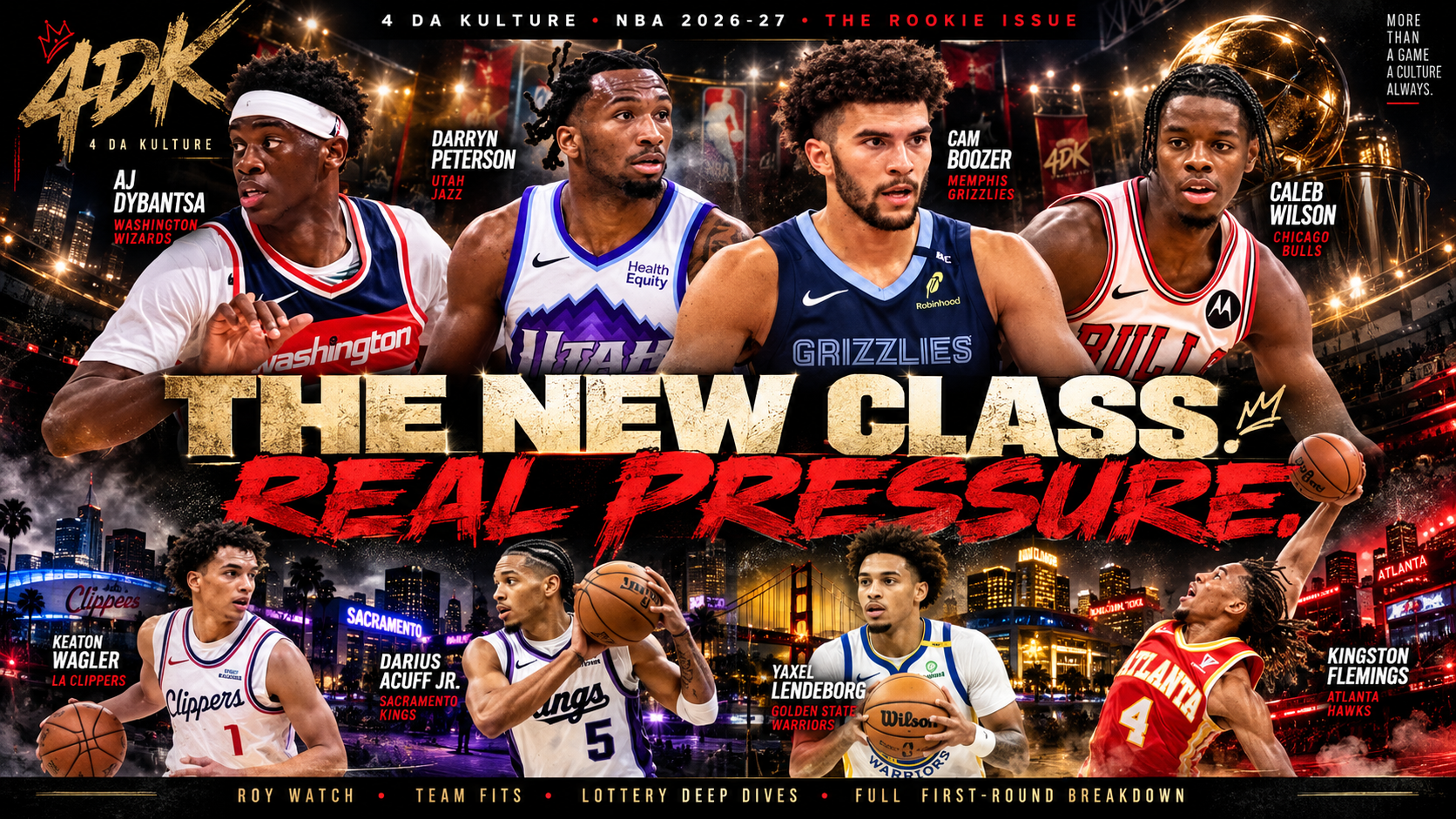
AJ has star pressure in Washington. Darryn has to fit into a young Utah core without shrinking his own ceiling. Cam Boozer is becoming the face of the post-Ja reset in Memphis. Caleb Wilson walks into Chicago with franchise-player expectations. And that is only the beginning.

FULL FIRST ROUNDLOTTERY DEEP DIVESTEAM FITSROY WATCH4DK ANALYSIS

Every draft class gets introduced as the future. This one arrives with enough talent — and enough completely different team situations — that the better question is not simply who is the best rookie? It is what each organization is asking its rookie to become.

Some guys are walking into rebuilds with a green light. Some are joining playoff teams where one blown rotation can put them back on the bench. Some have veteran stars making life easier. Some are being asked to become the star. And for the young point guards, the biggest challenge may not be talent at all. It may be surviving the physical and mental grind of running an NBA team for 82 games.

That is how we are looking at the 2026 class at 4 Da Kulture. Not as thirty isolated prospects. As thirty players entering thirty different ecosystems.

4 Da Kulture 2026-27 NBA Rookie Watch featuring AJ Dybantsa, Darryn Peterson, Cameron Boozer, Caleb Wilson, Darius Acuff Jr. and Keaton Wagler
1AJ DybantsaWashington • Wing Star Test
2Darryn PetersonUtah • Franchise Guard Test
3Cameron BoozerMemphis • Centerpiece Test
4Caleb WilsonChicago • Rebuild Leader Test
5Keaton WaglerClippers • Early Green Light
6Mikel Brown Jr.Brooklyn • Separate Yourself
7Darius Acuff Jr.Sacramento • Run The Show
8Kingston FlemingsAtlanta • Earn Every Minute
1WASHINGTON WIZARDS • AJ DYBANTSA

HOW LONG BEFORE AJ BECOMES TOP TWO IN THE OFFENSE?

The No. 1 pick has star expectations, but Washington does not need to throw him into an empty offense and hope he survives.

AJ walks into one of the strangest situations for a No. 1 pick. The Wizards still need to prove the rebuild is going somewhere, but they are not surrounding him with nothing. Trae Young gives Washington a legitimate organizer. Anthony Davis gives them a veteran two-way star when healthy. Alex Sarr has already shown real growth, and the roster still includes young wings and guards Washington is trying to evaluate.

That structure should help AJ. He does not need to spend October bringing the ball up against pressure, calling every set and then creating a bailout shot with six seconds left. Trae can bend the defense first. AD and Sarr can occupy the paint. AJ can attack a defense that has already moved.

The question is how long that lasts before the offense starts bending toward him. No. 1 picks with AJ's physical tools do not stay complementary forever if the scoring translates. We expect the first part of the season to be about learning where his NBA advantages are. By the middle of the year, Washington should be testing him in bigger late-clock and fourth-quarter possessions.

By March, the real conversation may be whether AJ has already become Washington's second offensive option — and whether there are nights when he looks like the first.

There is also an efficiency challenge. On a roster with multiple veterans and young players who need touches, AJ cannot measure progress only through shot attempts. The rookie version of winning basketball will be learning when to attack, when to cut, when to move it, and when the matchup is telling him to take over.

2UTAH JAZZ • DARRYN PETERSON

CAN DARRYN BECOME UTAH'S NEXT FRANCHISE GUARD WITHOUT BREAKING THE CORE?

Peterson is not walking into an empty rebuild. Utah already has Keyonte, Lauri, Ace, Collier and real decisions to make.

This is one of the most interesting rookie situations in the league because Utah already has young players who believe they are part of the future.

Keyonte George is not some placeholder point guard waiting for the No. 2 pick to take his job. He established himself as a legitimate scorer and Utah committed to him long term. Lauri Markkanen is still a proven scoring forward. Jaren Jackson Jr. gives the Jazz a veteran defensive anchor and frontcourt scorer. Ace Bailey showed real progress during the second half of his rookie season. And Isaiah Collier has already shown a natural ability to create shots for teammates.

That means Peterson's first challenge is not "save Utah." It is fit into something promising without shrinking his own ceiling.

The Keyonte-Darryn backcourt is where this gets real. Both can create. Both can score. Both are young enough that Utah should not force a final hierarchy in October. The best version is not one guard standing around while the other plays. Peterson has to prove he can punish closeouts, score off movement and make quick decisions without needing every possession to start in his hands. Keyonte has to show he can toggle between lead creator and scorer.

Lauri helps because he does not require a ball-stopping role to create offense. He can screen, pop, cut, attack a mismatch and punish a defense that tilts toward the guards. JJJ can give them a defensive backbone that last year's Jazz desperately needed.

Then there is Ace. We already viewed Bailey as one of Utah's highest-upside pieces, and his late-rookie growth makes the roster puzzle even more interesting. If Utah uses Ace as an aggressive second-unit scorer and still closes with him when the matchup works, the Jazz can develop all of these young players without forcing everyone to hunt the same shots.

Collier matters too. A guard whose first instinct is to organize can keep lineups functional when Keyonte or Peterson sits. That allows Peterson to spend some minutes simply being a scorer rather than always being responsible for the entire offense.

Our Donovan Mitchell question is about role, not a prediction that Darryn becomes Donovan. Mitchell eventually became the Jazz perimeter star who could create a quality shot when structure failed. Peterson has that kind of self-creation upside. If we reach March and Utah is putting the ball in Darryn's hands for big possessions while still getting growth from Keyonte and Ace, the entire rebuild starts to look different.

Earlier in our 4DK offseason work, Peterson was our ROY lean. We have not cooled on the player. The difference now is that Utah's full roster makes his rookie year less about volume and more about learning how to become a star inside a real ecosystem.
3MEMPHIS GRIZZLIES • CAMERON BOOZER

THE CENTERPIECE OF THE POST-JA MOVEMENT?

Memphis is not adding Boozer to the old Grizzlies. Memphis is asking him to help define whatever comes next.

This is the rookie whose team situation has changed the most important question around him.

Before the draft, the conversation was mostly about translation: is Cam big enough, quick enough and dynamic enough to become a star frontcourt scorer in the NBA? Now the organizational context is just as important. The Ja Morant-Jaren Jackson Jr. era is over. Memphis is not trying to squeeze one more playoff run out of that group. It needs a new basketball identity.

Boozer gets a chance to become the face of that identity. Cedric Coward, Zach Edey and other young pieces matter, but Cam is the top-three pick Memphis can gradually build the next version of the franchise around if he proves he deserves it.

That makes Year 1 less about wins and more about answers. Can Memphis run offense through Boozer at the elbow? Can he punish smaller defenders without becoming predictable? Can he make the extra pass quickly enough to become an offensive hub? Can his jumper keep a Boozer-Edey frontcourt from getting cramped? Can he survive when teams force him to defend in space over and over?

His biggest advantage is that his game already has connective value. He rebounds. He sees the floor. He can score without needing a dozen dribbles. He understands where to be. Those traits usually survive the jump from college to the NBA better than a game built entirely around athletic dominance.

The next step is proving he can create offense when the easy read is gone. Franchise players eventually have to generate something when the scouting report takes away Option A.

Memphis can let him learn through that. The Grizzlies do not need to bench him because he has a 4-for-15 night in November. They need to find out what happens when Cam sees the same coverage ten times and starts solving it.

4CHICAGO BULLS • CALEB WILSON

IS THIS FINALLY THE GUY CHICAGO CAN BUILD AROUND?

The Bulls are in a real rebuild now. Development has to matter more than pretending 38 wins means progress.

We have been consistent on Chicago: this season should be about development first, record second. A 35-win season with clear growth from the core can be a success. Fighting for the Play-In would be an overachievement if it comes naturally. Chasing it by blocking young players would defeat the purpose.

Josh Giddey is important because we already view him as a legitimate lead guard. He has shown he can organize an offense, rebound his position and create for teammates. Matas Buzelis is important because his next step can change the entire shape of the rebuild. We have already circled him as a potential Most Improved-type player if the growth is real.

And then Chicago drafted Caleb Wilson fourth.

That is where the ceiling changes.

Wilson does not have to arrive and immediately average 22. That would actually miss the point. Giddey can make his life easier. Norman Powell can absorb difficult veteran scoring possessions. Nic Claxton can handle a lot of ugly defensive work. Tiago Splitter has the opportunity to build a culture where Wilson learns how winning possessions work before the Bulls ask him to become the entire offense.

But by the second half of the season, we want to see the menu expand. Put him in more actions. Let him attack from different spots. Give him late-clock reps. See whether he can create a good shot instead of only finishing the shots somebody else creates.

The Wilson-Buzelis pairing is the part we are most interested in. If Buzelis really takes the step we expect and Wilson looks like a future primary scorer, Chicago could suddenly have two versatile forwards who fit the modern game. Add Giddey as the organizer, and the rebuild starts to have an actual basketball identity instead of just a collection of prospects.

Dailyn Swain at No. 15 gives them another long-term swing. That matters because rebuilding teams should be trying to stack compatible young talent, not searching for one savior.

Wilson has the highest long-term No. 1-option upside on this roster. Year 1 is about finding out how quickly that upside can become responsibility.

5LA CLIPPERS • KEATON WAGLER

INGRAM'S INJURY MAY HAVE GIVEN WAGLER A GREENER LIGHT THAN EXPECTED

The Clippers could have eased him in. Now they may need him to create sooner.

Wagler already had one of the fastest rises in the class. Now his rookie role may accelerate just as quickly.

The original Clippers setup looked ideal for a young guard. Darius Garland could handle the primary creation. Brandon Ingram could absorb a major scoring load. Veterans could keep the offense organized while Wagler learned how to defend, shoot, attack tilted defenses and gradually expand his on-ball work.

Then Ingram's heel surgery — with a partial Achilles tear addressed in the procedure — put his start to the season on hold with no firm return timetable.

Those touches do not disappear. Somebody has to take those shots. Somebody has to create when Garland sits or when the first action dies.

That gives Wagler a chance to earn more offensive responsibility than the Clippers probably envisioned on draft night. It also gives opposing defenses a reason to test him immediately. They will pressure the handle. They will force him into secondary reads. They will make him defend through multiple actions and see whether the one-year explosion at Illinois is the beginning of something durable.

We like the fact that Garland is there. Wagler does not need to pretend he is a full-time point guard before he is ready. He can learn how to be an NBA guard first: make quick decisions, defend his position, attack closeouts and punish the defense when it ignores him.

If Ingram misses significant time, the Clippers should not be scared of the mistakes. This is exactly the season to find out how much Wagler can handle.

6BROOKLYN NETS • MIKEL BROWN JR.

CAN BROWN SEPARATE HIMSELF FROM BROOKLYN'S GUARD CROWD?

Being the sixth pick guarantees opportunity. It does not guarantee Brooklyn decides you are the guard of its future.

Brooklyn already has Egor Dëmin and Nolan Traoré in a young guard group that still needs evaluation. Now Mikel Brown Jr. enters that mix while Julius Randle and Michael Porter Jr. raise the veteran floor around them.

That means Brown's rookie season is partly an internal competition. Can he give Brooklyn something the other guards do not? Can he score efficiently without hijacking possessions? Can he defend enough to stay on the floor? Can he play next to another creator instead of needing the lineup built around him?

This is a good situation for exposing habits. Brooklyn has enough young players that minutes should not be gifted forever. If Brown wants the organization to prioritize him, he has to force that decision with his play.

We expect flashes before consistency. What matters is whether those flashes start connecting into a clear role by the second half.

7SACRAMENTO KINGS • DARIUS ACUFF JR.

WELCOME TO THE 82-GAME POINT-GUARD GAUNTLET

Sacramento is giving Acuff the kind of responsibility most rookie guards say they want — until the league starts testing every decision.

Acuff may have the clearest path to immediate control among the rookie guards. Sacramento is rebuilding the offense around a younger timeline while still having veterans like Zach LaVine, Domantas Sabonis, Keegan Murray and Malik Monk.

That sounds perfect until you remember what running an NBA offense actually means.

You have to get Sabonis touches. You have to recognize when LaVine needs the ball. You have to know which matchup Sacramento wants to attack, when to speed the game up, when to slow it down and when the defense has already blown up the play before you finish calling it.

Then you have to defend another NBA guard on the other end.

Then do it again tomorrow.

This is why we are not going to overreact to Acuff's rookie turnovers or ugly shooting nights. If Sacramento truly believes he can become its long-term lead guard, it has to let him learn through real responsibility.

The important numbers will not only be points and assists. We are watching pace. Turnovers. Paint touches. How often he creates advantages for somebody else. Whether he can manage the emotional part of a game after three bad possessions in a row.

8ATLANTA HAWKS • KINGSTON FLEMINGS

ATLANTA IS NOT GIVING HIM ANYTHING. GOOD.

Flemings joins a playoff team with one of the deepest perimeter rotations in the league. His rookie numbers may be smaller. His basketball education may be better.

Atlanta already has Jalen Johnson as its centerpiece and a veteran guard group featuring CJ McCollum, Nickeil Alexander-Walker, Dyson Daniels, Lu Dort and other rotation options. That is a very different rookie environment from Sacramento.

Flemings is going to have to earn trust.

Miss a rotation? There is another guard ready.

Turn the ball over carelessly? Quin Snyder does not have to leave him out there for 35 minutes because the roster has no alternatives.

That can be frustrating for a lottery pick. It can also build better habits.

Learning from McCollum matters because CJ has made a long career out of creating efficient offense without being the biggest or most explosive guard on the floor. Flemings can study pace, footwork, how to use screens and how veteran scorers get to spots without wasting motion.

If the shot translates and the defense gets him onto the floor, Atlanta can bring him along without forcing him to become something before he is ready.

9DALLAS MAVERICKS • MOREZ JOHNSON JR.

DUSTY MAY ALREADY KNOWS EXACTLY WHAT HE'S GETTING

A rookie following his national-title coach to the NBA removes one of the biggest Year 1 variables: trust.

Morez played for Dusty May at Michigan. Now May is taking over Dallas and Morez arrives with him. That familiarity matters more than people think.

May already knows what Morez understands defensively, which mistakes he repeats, what motivates him, where he can be trusted and which parts of the offense need to stay simple. Morez already knows what his coach means when he asks for a specific coverage or demands a different level of physicality.

Dallas is building around Cooper Flagg. That should simplify Morez's job even more. He does not need to become a 20-point scorer. He needs to become the kind of frontcourt partner who lets Flagg do more of what makes Flagg special.

Rebound. Defend. Run. Screen. Switch. Protect the paint. Punish smaller players. Make the quick pass. If the jumper expands, great. But Dallas can get real value before that.

The best version of this pick is not Morez becoming the star. It is Morez becoming one of those players every contender eventually needs next to its star.

10MILWAUKEE BUCKS • BRAYDEN BURRIES

THE FIRST REAL DRAFT BUILDING BLOCK OF THE POST-GIANNIS ERA

Milwaukee spent years drafting for a championship window. Now it can finally draft for development again.

Everything about Milwaukee's timeline changed when Giannis left for Miami. Tyler Herro gives the Bucks a veteran scorer. Kel'el Ware, Jaime Jaquez Jr. and other young players give them pieces to evaluate. But Burries and Nate Ament represent something different: high draft investment made specifically for the next version of the Bucks.

Burries' physical profile and two-way potential should get him on the floor. The bigger question is how much offense is there long term. Can he become more than a useful strong guard? Can he create advantages? Can he defend up a position while still giving Milwaukee enough shooting and playmaking?

The good news is the Bucks do not need the answer in six weeks. This is what a rebuild is supposed to be: play the young talent, let roles expand naturally and learn who deserves to be part of the next serious Milwaukee team.

11GOLDEN STATE WARRIORS • YAXEL LENDEBORG

THIS DUDE FEELS LIKE HE WAS DRAFTED TO BE A WARRIOR

Older rookie. Strong. Versatile. Smart. Can pass, defend and make connective plays. Golden State may have found a system fit and a bridge piece at the same time.

Yaxel is entering the league older than most of this lottery group, and in Golden State that may be an advantage. The Warriors are still trying to squeeze winning basketball out of the Steph Curry and Draymond Green era. Jimmy Butler is expected back later from his knee injury. Kristaps Porziņģis gives them another veteran frontcourt skill set.

This is not a team that needs Yaxel to learn basketball from scratch.

He needs to learn Warriors basketball.

Where does Steph want the screen? When does Draymond slip out instead of holding contact? Which back cut becomes available when a defense top-locks a shooter? When does Golden State need the ball moved immediately instead of held?

Those are advanced questions, but Yaxel's age and versatility are exactly why the fit makes sense. Summer League already showed he can impact a game without needing to be the primary scorer. Now he gets to learn from some of the best decision-makers of this era.

Steve Kerr also has a real lineup question: is Lendeborg primarily a backup to Draymond, or can they play together? If the answer is both, Yaxel's path to minutes gets much clearer.

Long term, this matters beyond one season. Golden State desperately needs players who can help now without being useless when the Curry era finally ends. Yaxel has a chance to become that kind of bridge.

12OKLAHOMA CITY THUNDER • ADAY MARA

A 7-FOOT-3 PROJECT ENTERS A TEAM THAT DOESN'T NEED TO RUSH HIM

That might be the best thing that could have happened to Mara.

OKC is the opposite of the typical lottery destination. The Thunder already have Shai Gilgeous-Alexander, Jalen Williams, Chet Holmgren and a championship-level infrastructure. Mara does not have to save anything.

That gives the organization room to focus on development details that matter for a 7-foot-3 prospect: strength, mobility, defensive positioning, screening angles, how quickly he processes NBA spacing and whether he can stay playable when teams pull him away from the rim.

Some rookies need minutes. Mara needs the right minutes.

OKC can use developmental assignments. It can experiment with lineups. It can protect him from matchups that make no sense in October and revisit them later. Contenders almost never get to take a swing this large without needing immediate production.

13MILWAUKEE BUCKS • NATE AMENT

MILWAUKEE GETS A SECOND CHANCE TO FIND A REAL STAR

Burries may be the steadier two-way bet. Ament might be the bigger offensive swing.

Ament gives the Bucks exactly what a rebuild should want: another high-ceiling prospect whose development does not have to be rushed by championship expectations.

Milwaukee can play Burries and Ament together, separately and in different roles while Tyler Herro carries enough offense to keep the team functional. Kel'el Ware can cover mistakes around the rim. The entire year should be about expanding what the young players can handle instead of protecting a win-now hierarchy that no longer exists.

Ament's rookie efficiency may bounce around. That is not our main concern. We want to see whether the skill package translates against NBA length and whether Milwaukee can gradually give him more self-created offense without losing team structure.

14CHARLOTTE HORNETS • HANNES STEINBACH

CAN HE BECOME THE BIG WHO MAKES THE YOUNG WINGS' LIVES EASIER?

Charlotte's future revolves around its young perimeter talent. Steinbach does not need to dominate the ball to become important.

The Hornets' direction is increasingly about building around Brandon Miller and Kon Knueppel. That makes Steinbach's Year 1 checklist pretty straightforward.

Rebound. Screen. Finish. Protect space. Make the quick pass. Compete defensively.

If he can do those things consistently, Charlotte does not need him to become a post-up star. It needs a frontcourt player who helps the young wings operate with more room and more structure.

The frontcourt competition means minutes are not automatic, which is healthy. Steinbach will have to prove which parts of his college game survive immediately and which need time.

PICKS 15–30

WHO OUTPLAYS THE DRAFT SLOT?

The lottery gets the hype. The back half of the first round is where teams can change a rotation — or a rebuild — without paying lottery prices.

15

Dailyn Swain

Chicago Bulls

Wilson is the headline, but Swain gives Chicago another versatile forward to develop beside Giddey and Buzelis. If the defense, handle and secondary playmaking translate, the Bulls could eventually have a huge multi-forward lineup instead of a one-prospect rebuild.

4DK EXPECTATION: Development first. By the second half, challenge for real rotation minutes without taking touches away from the Wilson/Buzelis evaluation.
16

Bennett Stirtz

Oklahoma City Thunder

Another experienced, intelligent guard enters the deepest developmental machine in the league. The challenge is not learning how to play; it is finding minutes behind a championship-level rotation.

4DK EXPECTATION: Low rookie usage, high developmental value. Earn trust through decision-making and defense.
17

Ebuka Okorie

Detroit Pistons

Detroit is not desperate for a rookie guard to save the offense because Cade Cunningham already controls the team. That can help Okorie learn to impact games without dominating the ball.

4DK EXPECTATION: Defend, play fast, make simple reads and show he can function next to Cade rather than only behind him.
18

Christian Anderson

Charlotte Hornets

Charlotte's long-term guard picture is open enough for Anderson to matter, but the franchise does not need him forcing the issue immediately. Miller and Knueppel are the perimeter priorities.

4DK EXPECTATION: Learn the league now; build toward a larger lead-guard role later.
19

Allen Graves

Toronto Raptors

Toronto expects to win, so Graves needs a skill that survives immediately. Defense, shooting and quick decisions are his cleanest path to staying on the court around established veterans.

4DK EXPECTATION: Earn trust before earning shots.
20

Jayden Quaintance

San Antonio Spurs

The long-term idea is nasty: another mobile defensive athlete developing beside Wemby. San Antonio is good enough to be patient and should be. The Spurs do not need to squeeze immediate production out of him.

4DK EXPECTATION: Health and development first. Any meaningful rotation contribution is a bonus.
21

Karim López

Memphis Grizzlies

Post-Ja Memphis cannot be only the Cam Boozer show. The Grizzlies need to identify two, three and four young players who can grow with him. López gets a real opportunity to become part of that second layer.

4DK EXPECTATION: Developmental wing minutes with an eye toward becoming one of Boozer's long-term running mates.
22

Labaron Philon Jr.

Philadelphia 76ers

Philly is loaded with established creation, which means Philon will not have a rookie green light. That might be good for him. He can learn how to defend, push pace and survive meaningful possessions without being asked to carry offense.

4DK EXPECTATION: Smaller numbers, high-level apprenticeship.
23

Zuby Ejiofor

Atlanta Hawks

Atlanta has depth, but energy bigs can always create a role. If Zuby rebounds, protects the rim and plays with force, Quin Snyder can find situational minutes without running a single play for him.

4DK EXPECTATION: Spot minutes early; trusted energy big by the second half if the defense translates.
24

Cameron Carr

Los Angeles Lakers

The Lakers are not rebuilding around a rookie. They are trying to win around Luka. Carr's path is the classic contender-rookie path: guard wings, run the floor and hit enough open shots that the stars trust him.

4DK EXPECTATION: Compete for a real bench-wing role without needing touches drawn up for him.
25

Sergio De Larrea

Dallas Mavericks

Dallas gets a 6-foot-6 creator to develop inside the Cooper Flagg era. Because the Mavericks already have several young priorities, Sergio can be brought along gradually instead of being forced into a lead-guard role.

4DK EXPECTATION: Long-term development over immediate production.
26

Tarris Reed Jr.

San Antonio Spurs

Reed has a simple path to usefulness: give Wemby rest, rebound, screen and protect the rim. Simple does not mean easy, but it gives him a clearer Year 1 role than many players drafted ahead of him.

4DK EXPECTATION: One of the late picks with a realistic shot at immediate rotation minutes.
27

Chris Cenac Jr.

Boston Celtics

Boston can develop Cenac behind veterans instead of asking him to fix the frontcourt on Day 1. The physical tools are the appeal; the rookie season is about learning to survive NBA strength and speed.

4DK EXPECTATION: Physical development first. Any playoff-caliber rotation role is a bonus.
28

Joshua Jefferson

Brooklyn Nets

Brooklyn has a lot of young players who need the ball. Jefferson's advantage may be that he does not. Guard, rebound, cut, pass and make himself useful next to higher-usage prospects.

4DK EXPECTATION: Sneaky rotation candidate because his value does not depend on fifteen shots.
29

Alex Karaban

Sacramento Kings

We like this fit next to Acuff. Rookie point guards need spacing and players who know where to be. Karaban's shooting and feel can make Acuff's job easier without needing the offense designed around him.

4DK EXPECTATION: A real chance to outperform No. 29 because his role fits the roster immediately.
30

Koa Peat

Phoenix Suns

A former blue-chip talent landing at 30 is exactly the type of swing worth taking. Phoenix can ask Peat to bring physicality first and let the offensive game develop without lottery-level pressure.

4DK EXPECTATION: Physical bench-forward role early; real upside if the skill catches back up to the pedigree.
THE DEVELOPMENT TEST

THE POINT-GUARD GAUNTLET

Brown, Acuff, Flemings, Anderson and Okorie are entering a league where the point guard position demands more than skill. You are managing matchups, coverages, teammates, tempo and fatigue while elite guards hunt you every night. That is why we will not judge rookie guards only by field-goal percentage.

DECISION-MAKINGCan he diagnose coverage before the second defender arrives?
PHYSICAL SURVIVALCan he handle pressure, contact, travel and back-to-backs without losing his legs?
TEAM CONTROLCan he keep veterans involved, manage pace and understand when the game needs something different?
4DK PRESEASON ROOKIE OF THE YEAR WATCH

WHO TAKES ROY?

Our top four entering the season are not simply the four players we think have the highest ceilings. They are the four whose talent and opportunity give them the cleanest path to a major rookie role.

1Cameron BoozerMemphis needs a centerpiece and can let him grow through mistakes.
2AJ DybantsaHighest immediate wing-scoring upside with real veterans around him.
3Darryn PetersonStar guard talent, though Utah's depth may balance his raw volume.
4Caleb WilsonThe wildcard if Chicago gives him more creation responsibility early.
Our preseason pick: CAMERON BOOZER, by a hair. Not because we are declaring him the best long-term player in the class, but because Memphis gives him the cleanest combination of readiness, touches and organizational freedom.
4DK FINAL TAKE

THIS CLASS IS BIGGER THAN THE ROOKIE OF THE YEAR TROPHY.

AJ might become Washington's star wing. Peterson could become Utah's next major perimeter centerpiece without destroying the Keyonte-Ace timeline. Boozer has an entire franchise searching for a new identity. Wilson is being given the kind of development runway Chicago has needed for years. Wagler may be thrown into the fire faster than planned. Yaxel gets an NBA graduate course in Golden State. Morez gets his college coach and a role that already makes sense.

Acuff gets the keys. Flemings gets competition. Mara gets patience. Quaintance gets Wemby. Koa gets the chance to make teams regret letting him slide.

That is why we are watching all thirty. By April, somebody is going to be much better than we expected. Somebody is going to need more time. And somebody outside the lottery is going to make a bunch of front offices ask the same question.

How the hell did we let him get that far?
← BACK TO 4DK NBA