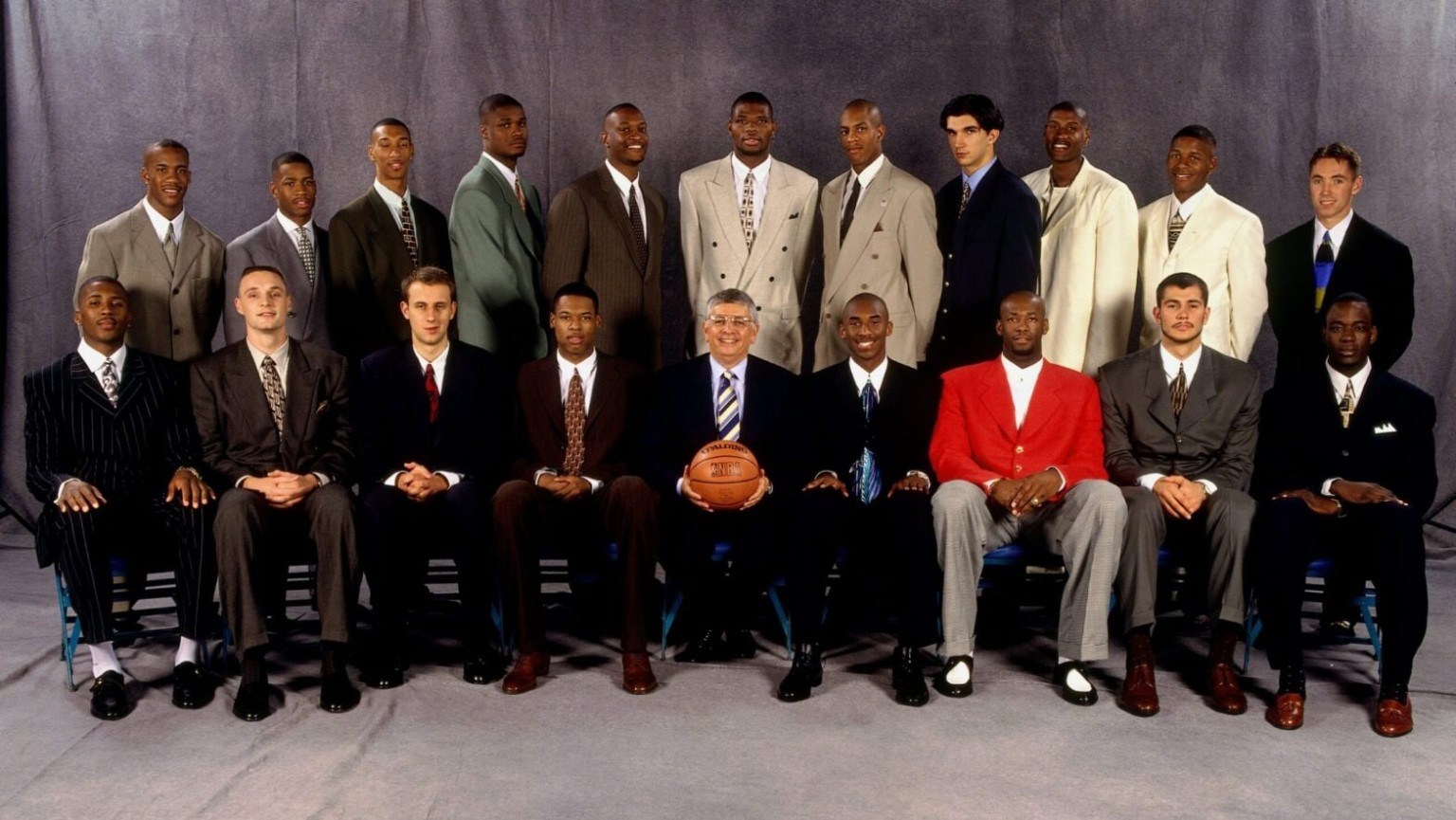
01. 1996–97: THE CLASS ARRIVES.
The first thing that makes the 1996 class special is how quickly so many of them mattered. Allen Iverson walked into Philadelphia and immediately became the center of the offense. Shareef Abdur-Rahim was productive from day one in Vancouver. Stephon Marbury looked like the point guard Minnesota had been waiting for next to Kevin Garnett. Marcus Camby blocked shots immediately. Antoine Walker was already filling box scores in Boston.
Iverson won Rookie of the Year at 23.5 points, 7.5 assists and 4.1 rebounds. Shareef averaged 18.7 and 6.9. Walker posted 17.5 points and 9.0 rebounds. Marbury gave Minnesota 15.8 points and 7.8 assists. Camby averaged 14.8 points, 6.3 rebounds and 2.1 blocks. Those five made All-Rookie First Team.
Ray Allen made the Second Team after averaging 13.4 points while shooting 39.3 percent from three. Kobe Bryant was there too, but his beginning looked completely different: 7.6 points in 15.5 minutes as an 18-year-old reserve on a deep Lakers team. He still made All-Rookie Second Team. That contrast is the whole class in miniature — some arrived ready, some needed time, and several would become much greater than their rookie numbers suggested.
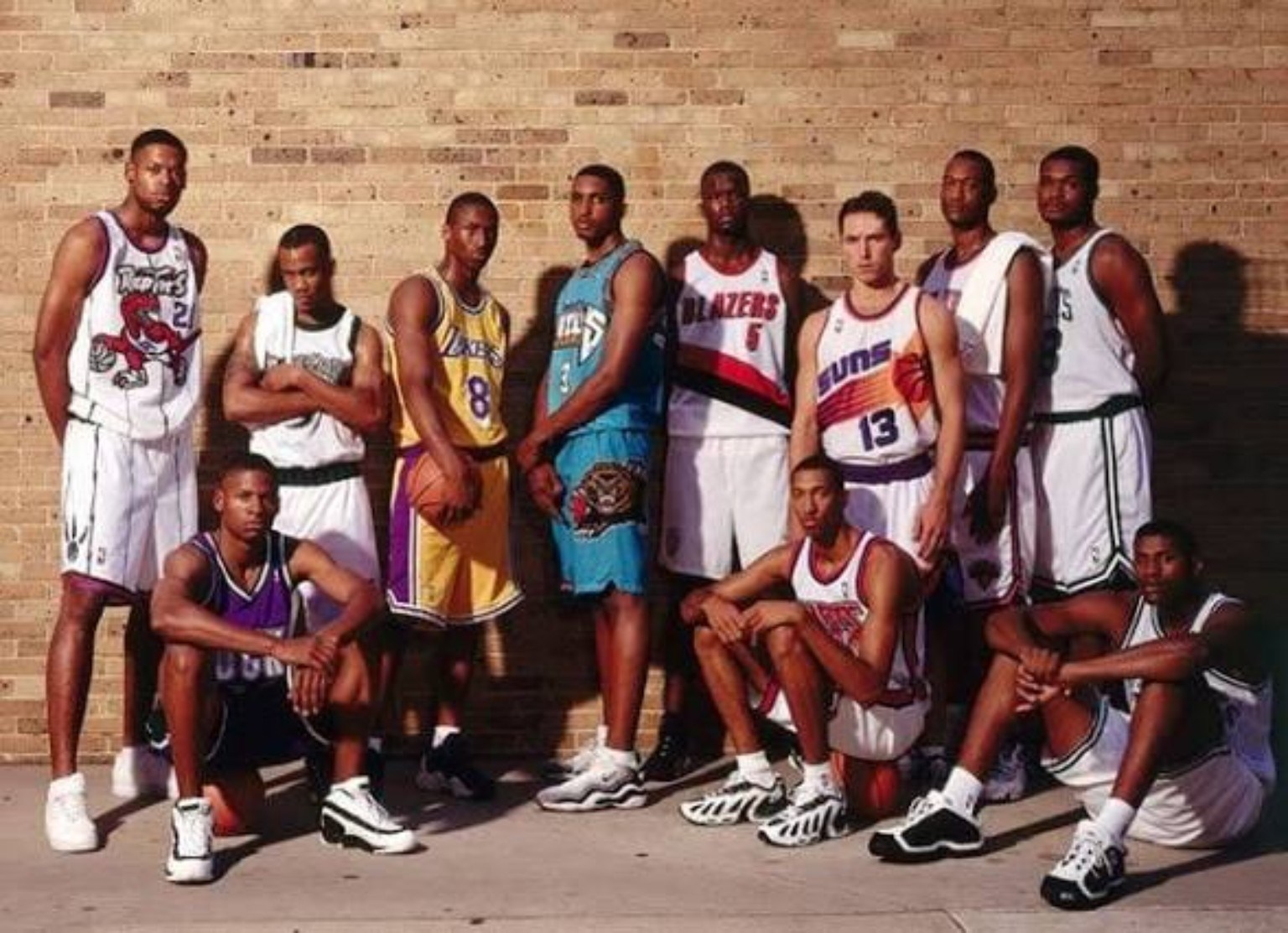
02. AI: FROM NO. 1 PICK TO MVP.
Iverson was the first pick and the first star of the class. What separated him was not just production. He changed the temperature of the league. The braids, tattoos, sleeves, crossover, speed and refusal to sand down his personality made him one of the most important cultural figures the NBA has ever had.
By 2000–01, the basketball résumé caught up with the impact. Iverson averaged 31.1 points, led the league in scoring and steals, played 42 minutes a night and carried Philadelphia to 56 wins and the No. 1 seed in the East. He received 93 first-place MVP votes. Then he took the Sixers to the Finals and handed the defending champion Lakers their only loss of that postseason in Game 1.
His career ended without a championship, and his efficiency will always be part of any modern evaluation. But reducing Iverson to percentages misses the burden he carried and the era he played in. He finished with an MVP, four scoring titles, 11 All-Star selections and seven All-NBA selections. In this class, only Kobe has a stronger combination of peak, longevity and cultural weight.
03. KOBE: NO. 13 BECOMES NO. 1.
The famous part is that Kobe went 13th. The more interesting part is why. NBA teams were not evaluating a future five-time champion. They were evaluating a 17-year-old high-school guard at a time when prep-to-pro guards were almost unheard of. Jerry West saw the upside differently.
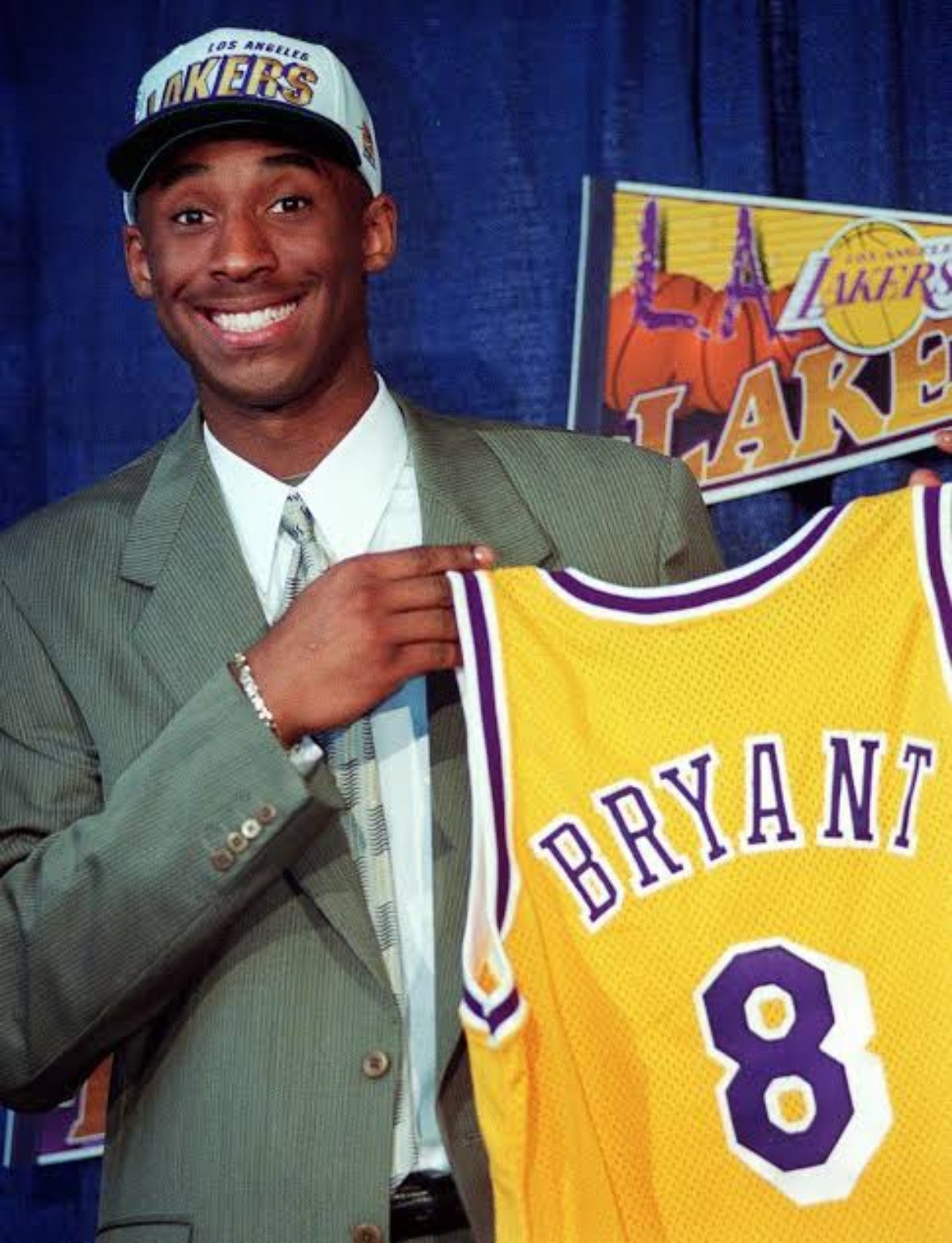
NO. 13 → LOS ANGELES.
Charlotte selected Kobe for the Lakers and traded his rights for Vlade Divac. Los Angeles then signed Shaquille O’Neal that summer. One offseason created the foundation of the next Lakers dynasty.
Kobe’s first season did not scream future legend. By Year 2 he was an All-Star. By Year 3 he was All-NBA. By his fourth season he was a champion. Twenty seasons later: five rings, one MVP, two Finals MVPs, two scoring titles, 18 All-Star selections and an all-Lakers career that turned the 13th pick into the defining draft-night steal of the era.
04. MARBURY + KG: THE MINNESOTA WHAT-IF.
Marbury might be the class’s biggest “what if?” Minnesota acquired him on draft night after Milwaukee selected him fourth, pairing the Brooklyn point guard with 20-year-old Kevin Garnett. The fit was immediate. Marbury averaged 15.8 points and 7.8 assists as a rookie, then 17.7 and 8.6 in Year 2.
The Wolves made the playoffs in each of Marbury’s first two seasons. The basketball idea made sense: KG could defend, rebound and finish everything; Marbury could break defenses off the dribble and create late in the clock. In 1998–99 Marbury was up to 21-plus points and nearly nine assists per game across his split season.
Then it ended. Contract and role tension, Garnett’s massive extension, and Marbury’s desire for a different situation helped lead to the 1999 three-team trade that sent him to New Jersey. He still built a strong NBA career — two All-Star selections, two All-NBA teams and career averages of 19.3 points and 7.6 assists — before becoming a basketball icon in China. But Minnesota remains one of the biggest alternate-history branches from the entire draft.
05. NASH: THE SLOWEST BURN BECOMES TWO MVPS.
Steve Nash is the best argument against judging a draft too early. Picked 15th, he averaged only 3.3 points and 2.1 assists as a rookie in Phoenix. Even after a trade to Dallas in 1998, his first season there was rough. There was no obvious MVP trajectory.
Then the game slowed down for him. Nash became an All-Star in Dallas, returned to Phoenix in 2004 and became the engine of one of the most influential offenses in modern NBA history. In 2004–05 he averaged 15.5 points and 11.5 assists and won MVP. In 2005–06, with Amar’e Stoudemire essentially lost for the year, Nash improved to 18.8 and 10.5 and won it again.
Back-to-back MVPs from the 15th pick is wild enough. The bigger legacy is stylistic. Pace, spacing, early offense, pull-up shooting and constant pick-and-roll pressure became the language of the next NBA. Nash did not invent all of it, but the Seven Seconds or Less Suns made it impossible to ignore.
06. RAY ALLEN: STAR, SHOOTER, SURVIVOR.
Ray Allen’s career is one of the cleanest examples of adaptation in league history. He entered the NBA as much more than a shooter — an athletic two-guard who could score off the bounce, attack the rim and create. Milwaukee got an immediate contributor, and he eventually became the face of a contender that reached the 2001 Eastern Conference Finals.
Then came Seattle, where Allen remained a high-volume scorer. Then Boston, where he accepted a smaller offensive role and became a championship piece next to Kevin Garnett and Paul Pierce. Then Miami, where the most famous shot of his career — the corner three in Game 6 of the 2013 Finals — extended a championship season.
Allen finished with 24,505 points, 10 All-Star selections, two championships and 2,973 made threes, the all-time record when he retired. In a class full of players who defined an era, Ray’s career might be the best example of staying elite by changing what “elite” looked like.
07. JERMAINE O’NEAL: FOUR QUIET YEARS, THEN A STAR.
Jermaine O’Neal went 17th straight out of high school and spent four years buried in Portland’s veteran frontcourt. He averaged only 4.1 points as a rookie and never reached four points per game in any of his first four seasons. If we had re-drafted the class in 2000, he would have been easy to underrate.
Indiana changed everything. After being traded for Dale Davis, O’Neal became Most Improved Player, then a six-time All-Star and three-time All-NBA selection. At his peak in 2003–04 he averaged 20.1 points, 10.0 rebounds and 2.6 blocks, finished third in MVP voting and led the 61-win Pacers to the Eastern Conference Finals.
His career is one of the reasons a 30-year review matters. Development is not linear. Some players tell you who they are immediately. Jermaine needed opportunity.
08. PEJA: AHEAD OF THE LEAGUE.
Peja Stojaković did not even come to the NBA immediately after Sacramento drafted him 14th. He stayed in Greece before arriving in 1998. By the early 2000s, he was one of the most dangerous movement shooters in basketball and a central part of the Kings teams that pushed the Shaq–Kobe Lakers harder than anyone in the West.
His peak was 2003–04: 24.2 points, 43.3 percent from three and 92.7 percent from the line. He made All-NBA Second Team and finished fourth in MVP voting. In a modern offense with even more three-point volume, prime Peja would look completely natural.
He finished as a three-time All-Star and later won a championship with Dallas in 2011. The 14th pick became one of the clearest bridges between 1990s forward play and the spacing-heavy league that followed.
09. CAMBY: DEFENSE NEVER NEEDED AN ALL-STAR BALLOT.
Marcus Camby was the No. 2 pick and made All-Rookie First Team, but he never became the traditional franchise scorer expected from that slot. Instead, his career bent toward defense. He became one of the best shot blockers and rebounders of his generation.
Camby played 17 seasons, won Defensive Player of the Year in 2007, led the league in blocks four times and remained useful deep into his 30s. He never made an All-Star team — one of the stranger résumé quirks in the class — but his defensive value lasted much longer than the absence of an All-Star nod suggests.
10. ANTOINE WALKER: FLAWED, PRODUCTIVE, IMPORTANT.
Antoine Walker is the kind of player whose career looks different depending on the era evaluating it. He was a 6-foot-9 forward who handled the ball, passed, rebounded and launched threes at huge volume long before that profile became normal.
He averaged 17.5 points, 9.0 rebounds and 3.2 assists as a rookie, made three All-Star teams and later won a championship with Miami in 2006. The drawbacks were real — low efficiency, questionable shot selection and a three-point appetite that often ran ahead of his accuracy. But he was also a legitimate star on Boston teams that returned to playoff relevance, including a trip to the 2002 Eastern Conference Finals.
11. THE REST OF THE CLASS THAT MATTERED.
SHAREEF ABDUR-RAHIM
Immediate producer: 18.7 points as a rookie and 18.1 for his career. He topped 15,000 points and made the 2002 All-Star team. His résumé is held back more by team context than by individual production.
ZYDRUNAS ILGAUSKAS
Foot injuries delayed his start, but Big Z became a two-time All-Star and one of Cleveland’s most important long-term players. His comeback story is part of the class’s depth.
DEREK FISHER
Never an All-Star, but five championships, the 0.4 shot, elite durability and decades of winning relevance make him one of the most valuable non-star careers in the class.
BEN WALLACE
The hidden giant of the class: Hall of Famer, four-time Defensive Player of the Year, four-time All-Star, five-time All-NBA and the defensive backbone of the 2004 champion Pistons.
12. HALL OF FAME + ALL-STAR SCOREBOARD.
If we count only players actually drafted in 1996, the class produced 10 All-Stars and four Hall of Famers: Iverson, Ray Allen, Kobe and Nash. If we evaluate the entire 1996 entry class and include undrafted Ben Wallace, the totals become 11 All-Stars and five Hall of Famers.
Broader class totals include undrafted Ben Wallace, who entered the NBA in 1996.
13. THE FULL 4DK FIRST-ROUND RE-DRAFT.
This time we are doing the whole thing: 29 first-round slots, not just a Top 10. We are drafting with full career hindsight and allowing every 1996-eligible player into the pool, including undrafted players. The criteria: peak, longevity, winning, awards, portability and how much value the player gave you over an NBA career.
The top tier is strong enough to argue forever. The back half is about useful NBA careers, not star power — exactly what a real first-round re-draft should show.
14. WHERE DOES 1996 RANK ALL-TIME?
There are three classes that belong at the front of this conversation: 1984, 1996 and 2003. The 1984 class has the strongest top-end case with Michael Jordan, Hakeem Olajuwon, Charles Barkley and John Stockton. The 2003 class has LeBron James, Dwyane Wade, Carmelo Anthony and Chris Bosh.
What makes 1996 different is the depth. Kobe, Iverson, Nash and Ray are already a ridiculous top four. Then you still have Ben Wallace, Jermaine O’Neal, Peja, Marbury, Camby, Shareef, Antoine Walker, Big Z and Fisher. You can get into the teens before the class stops producing players who had genuinely important NBA careers.
So 30 years later, 4DK has 1996 at No. 2 all-time. It has a legitimate argument for No. 1 if depth matters more to you than the unmatched top end of 1984. What is no longer debatable is whether the class belongs in that tier. It does.