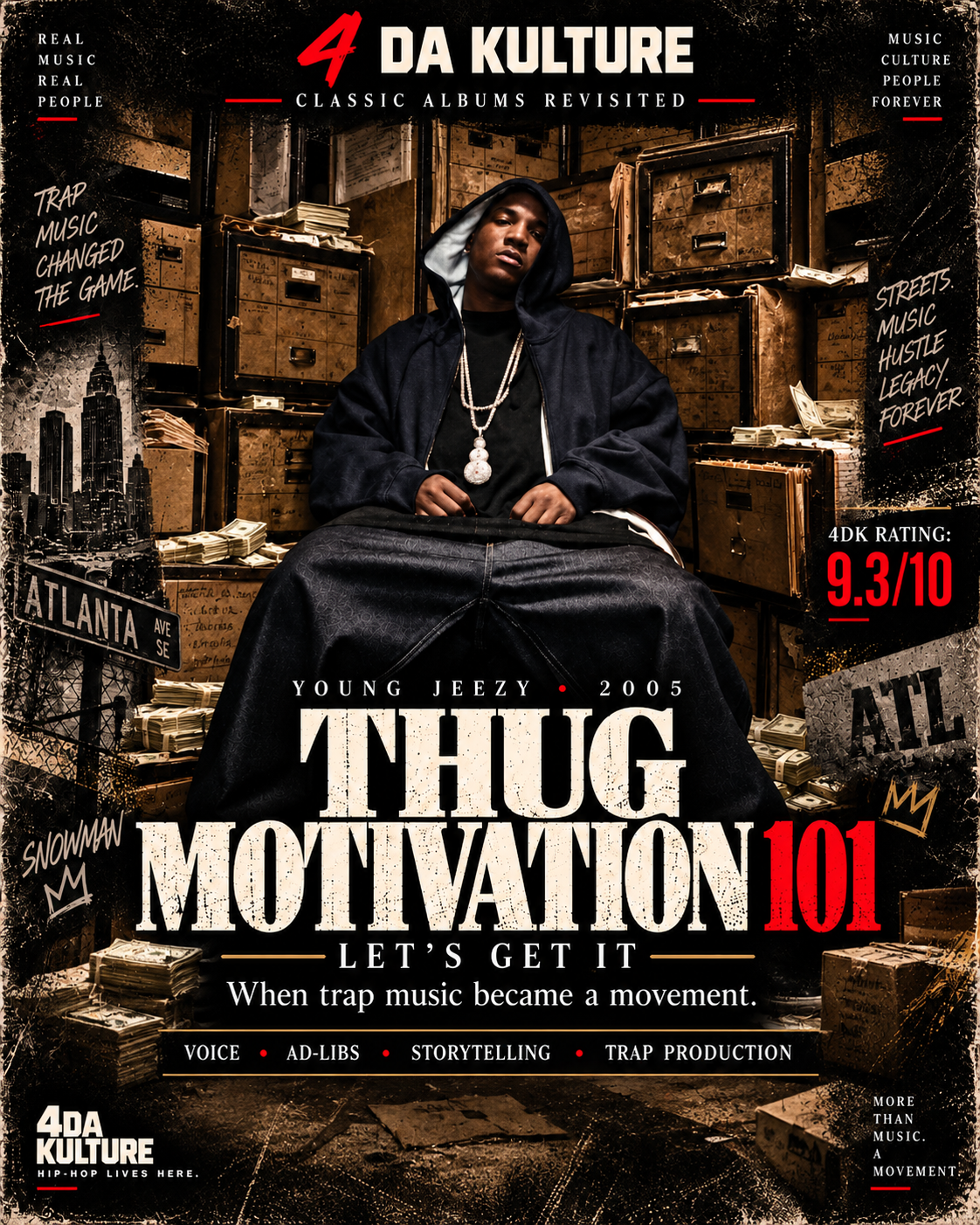
Some classic albums are important because history tells us they are important. Let’s Get It: Thug Motivation 101 is different for us. We remember what it felt like when the record was new. We remember being a sophomore in high school in California in 2005 and hearing a voice from Atlanta that sounded like nothing else in our rotation. That connection is part of this review because the reach is part of the story.
Jeezy did not need to be from our neighborhood for the music to feel personal. The literal details were his, but the emotional engine traveled: hunger, pressure, focus, survival, ambition, paranoia, confidence and the belief that the next level was somewhere in front of you if you kept moving. Every song seemed to carry a different piece of that feeling.
THE VOICE WAS PART OF THE BEAT.
There are rappers whose greatness starts with technical complexity. Jeezy’s greatness on TM101 starts somewhere else. His voice is an instrument. The rasp cuts through the low end. The pauses create space. The ad-libs finish thoughts. The way he stresses one word can do as much work as another rapper’s whole run of syllables.
That is why judging this album only by rhyme density misses the point. Jeezy understood emphasis. He understood how to make a line feel bigger because of where he placed it, how long he waited before the next one and what he yelled around it. His ad-libs became part percussion, part punctuation and part branding. You could hear a few seconds of a record and know exactly whose world you were in.
The storytelling matters just as much. Jeezy rarely sounds like he is describing the street from a safe distance. The tension comes from how lived-in the details feel: money arriving with consequences, success sitting next to surveillance, ambition sitting next to the possibility that everything can disappear. The record sells the fantasy and keeps the anxiety in the same frame.
TRAP WAS ALREADY HERE. JEEZY MADE HIS VERSION UNMISTAKABLE.
4DK is not rewriting Southern rap history to make this album look bigger. Trap music did not begin with TM101. Southern street rap had deep roots, and T.I.’s Trap Muzik had already given the term a major album identity two years earlier. What Jeezy did was bring a completely different personality to that evolution.
His version was colder, heavier and more motivational. The Snowman image, the voice, the ad-libs and the way he turned hustler talk into something that felt like a speech before a game made the music instantly identifiable. That is the difference between participating in a movement and creating a language inside it.
THE PRODUCTION BUILT ONE WORLD WITHOUT USING ONE BEAT.
Shawty Redd is central to the album’s coldest DNA. The title track, “Gangsta Music,” “Bottom of the Map,” “Get Ya Mind Right,” “Trap or Die,” “That’s How Ya Feel” and “Air Forces” all help establish that gothic, speaker-heavy atmosphere where Jeezy sounds completely at home. But the record is not nineteen versions of the same formula.
Drumma Boy gives “Standing Ovation” a triumphant lift. Midnight Black handles the wide-screen ambition of “Let’s Get It / Sky’s the Limit” and the club pressure of “Tear It Up.” Mannie Fresh brings his own bounce to “And Then What.” Don Cannon lets “Go Crazy” breathe over soul. Mr. Collipark makes “Trap Star” feel like a hook-first anthem. J.U.S.T.I.C.E. League gives “Don’t Get Caught” a dramatic backdrop. Akon builds a crossover frame for “Soul Survivor” without sanding Jeezy down.
That variety is important. TM101 does not have one beat. It has one world. The production can turn triumphant, soulful, club-ready or reflective and still sound like it belongs underneath the same Snowman.
THE DEEP CUTS ARE WHY THIS IS A CLASSIC.
The biggest records helped make Jeezy a star, but they are not the reason we rate the whole album this highly. Our favorite tier keeps dragging us back into the middle of the tracklist: “Gangsta Music,” “Bottom of the Map,” “Get Ya Mind Right,” “Trap Star,” “Don’t Get Caught,” “Trap or Die” and “Tear It Up.”
That matters because it separates an era-defining album from an album with era-defining singles. “Soul Survivor” can be the huge crossover moment and still not have to carry the project. “And Then What” can be one of the songs we play the least and the album still has another dozen records we would defend. There is depth everywhere.
We do not have a true skip. “Last of a Dying Breed” and “And Then What” simply fall to the bottom of an unusually strong rotation. That is not the same thing as calling them weak.
THE FEATURES SERVE JEEZY'S WORLD.
The guests are another reason the album stays balanced. T.I. on “Bang” brings Atlanta heavyweight energy without turning the song into a competition. Bun B on “Trap or Die” connects the record to an older Southern street-rap lineage and fits the beat naturally. Akon gives “Soul Survivor” a massive melodic hook while Jeezy stays completely Jeezy. Lloyd and Slick Pulla help “Tear It Up” move between club record and street record without either side feeling forced.
Even when the guest list expands on “Last of a Dying Breed,” the album never feels like a compilation. The center of gravity stays with Jeezy. That is what a strong debut statement is supposed to do.