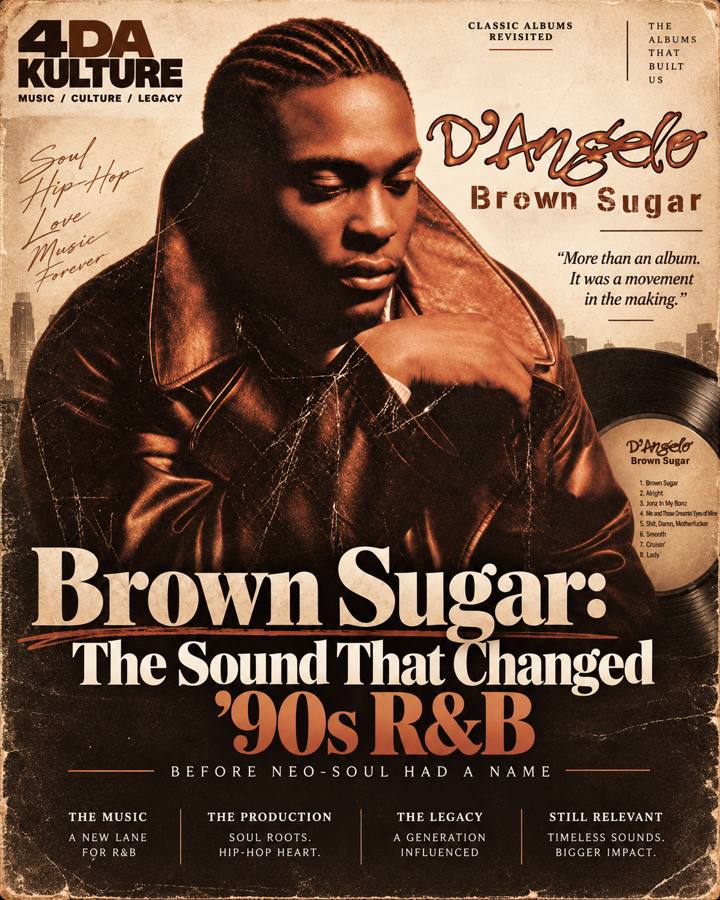
There are albums that become classics because they capture their era perfectly. Then there are albums that become classics because they help create the era that comes next. D'Angelo's Brown Sugar belongs in that second category. Released in 1995 when he was just 21, the album already sounded like the work of somebody who knew exactly what kind of musical world he wanted to build.
The simplest way I can describe it is this: it sounded like R&B on hip-hop beats. The songs were gas. The lyrics were catchy. The production was amazing. The samples were chosen with purpose. Most importantly, it didn't sound like everything else in R&B at the time.
A NEW LANE FOR R&B.
By the middle of the '90s, New Jack Swing had already dominated R&B for years. Brown Sugar felt like part of the next transition. The music was warmer, looser and more organic, but it was still modern. D'Angelo could bring gospel, funk and classic soul into the room while the drums and attitude still spoke to the hip-hop generation.
That is why the album belongs in the conversation when we talk about the road to Erykah Badu, Lauryn Hill, The Roots and the larger Soulquarians era. It wasn't the only record responsible for that movement, but it was one of the albums that broke the mold before “neo-soul” became the easy label for the sound.
Even the image was different from the clean-cut R&B star template. The cornrows and streetwear matched the music's attitude without becoming the point of the music. The songs were still the reason the album lasted.
THE TITLE TRACK IS THE MISSION STATEMENT.
“Brown Sugar” starts the album perfectly. The beat has a hip-hop feel, the vocals are pure soul, and the writing is slick enough to work on more than one level. The song plays like a love record on the surface while using “brown sugar” as a marijuana metaphor underneath it. That double meaning is part of what makes the record genius.
Ali Shaheed Muhammad of A Tribe Called Quest co-wrote and co-produced the title track with D'Angelo and handled drum programming. That connection matters because the hip-hop feel wasn't somebody painting a rap texture onto an R&B song after the fact. It was built into the record from the start.
THE PRODUCTION IS THE MONSTER.
The biggest strength of Brown Sugar is the way the production, songwriting and vocals fit together. It is soulful without sounding dated, hip-hop-minded without turning into a rap album, and musical without becoming overproduced.
D'Angelo handled most of the writing, arranging, production and instrumentation, but this was also a talented room. The collaborators deserve their flowers.
Vocals, writing, arranging, production and multi-instrumental work across the project.
Production, engineering, mixing, guitar and other musical contributions helped shape the album's warm but precise sound.
Co-writer and co-producer on “Brown Sugar,” with drum programming on the title track.
Co-writer, co-producer, bass and guitar on one of the album's most timeless records.
Co-writer on “Jonz in My Bonz,” one of 4DK's favorite hidden gems on the album.
Massenburg executive-produced the project; Elevado was among the engineers and mixers helping capture its texture.
That is why the album can move from the one-of-one groove of “Alright” to the darkness of “Shit, Damn, Motherfucker,” then to the warmth of “Lady” and the jazzy touches in “Me and Those Dreamin' Eyes of Mine” without sounding like four different albums.
The record draws from The Temprees' 1972 “Explain It to Her Mama.” The source helps give the drums their character, but the finished song still feels completely like D'Angelo's world.
The hidden gem samples Ralph Vargas and Carlos Bess' “Sticks.” It is another example of the album using source material as part of the texture instead of letting the sample become the whole idea.
And that distinction is important: Brown Sugar is not simply a sample-driven record. A lot of the old-soul feeling comes from musicians actually playing, arranging and building those sounds.